| Description | The Tomey Refractometer Keratometer and Topographer only in 1 unit senior citizens and children can also get the inspection with out any trouble because they dont have to move the seat for three measurements. | The new tri-functional Autorefractor Keratometer Topcon KR-8000PA Supra combines an autorefractor, an autokeratometer, and a computerized color corneal mapping system all in a single, compact unit! This enables the instrument to provide three times the diagnostic capabilities in one-third the space, at a fraction of the cost of the individual instruments. | New Handpiece Design The Optima – 518 Classic is the first model to use the new Mark II which enables a multipurpose handpiece:
* Faster treatments – up to 0.5 Seconds Between pulses.
* Real-time handpiece temperature control.
* Contemporary and stylish design.
* Light weight design – 25% less weight to improve the therapists’ comfort. | The Nidek RS-330 OCT is a combination of a High-Definition OCT and fundus camera. Optional delivery with FAF (Auto-fluorescence function) | The OPD-Scan III is an automated 5 in 1 instrument that combines topography, wavefront, autorefraction, keratometry, and pupillometry — allowing accurate and reliable analysis of corneal aberration. | The Sequoia system’s advanced technologies are designed to make image acquisition easier, reduce exam time and increase overall efficiency. Along with many other included features, the Sequoia system offers Native, a patient specific imaging which adapts both phase and amplitude information of each unique patient’s properties which delivers a consistently better image across a broad range of patients. |
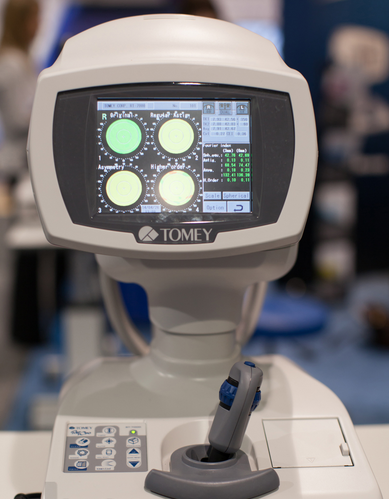
| Content | Tomey RT-7000 Autorefractor Keratometer Topographer
-Three Functions in One Instrument-Easy & Speedy Touch Screen Alignment-6.4 inches color TFT LCD-Dual CCD technology for Refractometry-IOL/ Cataract Mode-New incites for Keratometry KAI, KRI-Auto Alignment / Auto Shot of TopographyCorneal Topography– Auto Alignment / Auto ShotAny one can easily capture measurement with Auto Alignment and Auto Shot. The Measurement variation is significantly reduced no matter what the skill level is of the operator.CL Fitting Simulation-A pseudo-fluorescent pattern of the contact lens selected from the built-in data base can be confirmed and the fitting can be stimulated before the patient wears the trial lens.Corneal Eccentricity Index-The index of CEI (Corneal Eccentricity Index) indicates the ratio of flattering in percentage from the central cornea to the periphery.Three Function in One Instrument– Refractometer Keratometer and Topographer only in 1 unit senior citizens and children can also get the inspection with out any trouble because they don’t have to move the seat for three measurements. Switch from Ref-Kerato Mode to Corneal Topography Mode with only ONE TOUCH. The light come appears with only one button from the measuring head and the Ref-Keratometer is transformed to the topographer.Refractometry– Dual CCD technology for RefractometryTwo CCD cameras are used to capture images for observation and for measurement while providing highly accurate measurement data.Keratometory– New Indices for KeratometryThe Corneal Irregular astigmatism display function is installed to expand the possibility of Keratometer. This is the new function to measure the level of corneal irregular astigmatism which was difficult in the past.SPECIFICATIONSMeasurmentRangesRefraction MeasuremntSphere -25.00D to ±22.00DIVD=12.0mmCylinder 0D to ± 10.00DIVD=12.0mmAxis 0 to 180Corneal Curvature Measurement 5.00mm to 11.00mmMeasurement Zone 3mm R:8.00mmCorneal MappingDisplay Range 9 to 100 D-Normal Mode1.0 to 8.0mm (R:8.00mm)-Special Mode0.9 to 7.0 mm (R:8.00mm)Measurement TimeREF 0.2 SecondsKRT 0.1 SecondsMinimum Pupil Diameter 2.2mmMinimum Measurment Step Refraction MeasurementSphere 0.01DCylinder 0.01DAxis 1Corneal Curvature Measurement 0.01mmPD (Pupil Distance) 50mm to 86mmRecording Built-In Thermal PrinterVertex Distance 0mm, 12.0mm, 13.5mm, 14.0mm, 15.5mm, 16.0mmExterior Output (AN port / 4USB ports)Dimensions Tomey RT-7000 Autorefractor Keratometer TopographerHigh 466mmm or 18 InchesWidth 307mm or 12 InchesDepth 490mm or 19 InchesWeight Approx 20,000Kg / 44.4 PoundsDisplay 6.4 Inches color liquid crystalPower SupplyVoltage AC 100 to 240VFrequency 50/60 HzConsumption Power 120VA to 150VATemperature +10C to + 40CDisplay 30% to 75% | Topcon KR8000PA Autorefractor KeratometerBy implementing Topcon’s Autorefractor Keratometer Topcon KR-8000PA Supraexclusive rotary prism technology for the refraction portion of the measurement, the Autorefractor Keratometer Topcon KR-8000PA Supra provides objective data that is unmatched in accuracy and reliability. Auto tracking and auto measurement enhance the ease of operation. The Autorefractor Keratometer Topcon KR-8000PA Supra unit also incorporates ten placido rings for enhanced testing precision, providing corneal mapping measurements out to 10mm! |
Features for Autorefractor Keratometer Topcon KR-8000PA SupraTopcon Color Mapping 32 SoftwareThis versatile 32-bit color mapping software system enhances clinical evaluations with the output of highly accurate, full color corneal maps. The system offers an enlarged color map, tangential axial maps, sagittal maps, refractive and keratometric data, and peripheral keratometric maps. It provides early phase detection of subclinical keratoconus as well as pre and post-op evaluation. The software also features a new image overlay function, as well as a Multi-Map and Difference Map View, which display multiple image maps for easy comparison. The color mapping system is an excellent patient education tool and is designed for use with the Topcon KR-7000P or KR-8000PA Auto Refractor/Keratometer. Windows® 95/98/NT Compatible.
The color mapping software also features a contact lens fitting module with adjustable parameters to view the contact lens fit on screen.The Autorefractor Keratometer Topcon KR-8000PA Supra System Benefits Include:Topcon KR8000PA Autorefractor Keratometer- Allows Three Functions at One Station:
– Refraction
– Keratometry
– Corneal Mapping
- Contact Lens Fitting Utility
- Early Phase Detection of Subclinical Keratoconus
- Direct Link to CV System
The new tri-functional Autorefractor Keratometer Topcon KR-8000PA Supra combines an autorefractor, an autokeratometer, and a computerized color corneal mapping system all in a single, compact unit! This enables the instrument to provide three times the diagnostic capabilities in one-third the space, at a fraction of the cost of the individual instruments. | Active Optical Systems Optima 518 IPL LaserHandpiece (Standard):Multipurpose Wavelength Mark-II
Handpiece (Optional):Facial Treatments
Pulse Interval/Repetition Rate:0.5 – 2 Seconds
Maximum Output Treatment Pattern:22 Joule /cm 2
Output Power:11-31 Joule / cm 2 , up to 4000 W
Cooling System:Improved Air Cooling
Control:Advanced Software Interface
Lamp’s Life Span:200,000 Flashes (minimum)
Treatment Area/Spot Size:15 x 50 mm, (7.5 cm 2)
Wavelength:420 – 1,100 nm
Weight:88.18 lbs (40Kg) (including stand)
Dimensions:17.32 inches x 17.72 inches x 39.37 inches (44cm x 45cm x 100cm)
Mains:220-230 VAC, 50/60 Hz; 100-120 VAC, 50/60 Hz
Max Mains Power:600 VA
Treatments Variety:
Skin Rejuvenation
Pigmentation Treatment
Acne Treatment
Hair Removal
Hair Removal – Deep Follicles
Hair Removal – Sensitive Skin
Vascular (Facial) Treatment
Tattoo Removal
The Laser uses 12 preset programs. The programs are set in a consecutive, energy intensity increasing order, as specified by the tables of settings, covering all types of hair and skin combinations to be treated.
12 Programs
1 – Very Dark Skin, Fitzpatrick Skin Type IV
2 – Dark Skin, Fitzpatrick Skin Type IV
3 – Dark Skin, Fitzpatrick Skin Type III
4 – Dark Skin, Fitzpatrick Skin Type III
5 – Medium Skin, Fitzpatrick Skin Type II
6 – Medium Skin, Fitzpatrick Skin Type II
7 – Light Skin, Fitzpatrick Skin Type II
8 – Light Skin, Fitzpatrick Skin Type I
9 – Very Light Skin, Fitzpatrick Skin Type I
10 – Very Light Skin, Fitzpatrick Skin Type I
11 – Very Light Skin, Fitzpatrick Skin Type I
12 – High Power, Fitzpatrick Skin Type IOptima-518-Classic Active Optical Systems Optima 518 IPL LaserThe Optima – 518 Classic was designed to answer the needs of sophisticated practitioners who want to provide state of the art treatment to their patients on one hand, based on proven and tested treatment protocols and on the other hand to have the ability to reach new and improved protocols by conducting innovative clinical investigations.The Optima – 518 Classic, based on active’s GEM-PL technology, sets the pulse pattern according to the selected treatment type, skin color, skin photosensitivity and treatment depth. The treatment protocols and different pulse patterns take into account the tissue’s TRT (Thermal Relaxation Time) and the combined knowledge accumulated from thousands of treatments done during the years and clinical investigations done to confirm the findings.New Handpiece Design The Optima – 518 Classic is the first model to use the new Mark II which enables a multipurpose handpiece:
* Faster treatments – up to 0.5 Seconds Between pulses.
* Real-time handpiece temperature control.
* Contemporary and stylish design.
* Light weight design – 25% less weight to improve the therapists’ comfort.Research program for clinical investigations, the self setting program allows researchers to set the treatment’s parameters according to their needs. Allowing advanced research with the device. The energy levels in the self setting program can reach 31J cm 2 with high intensity of 4000 W.Approvals
* CE MDD Intl. Medical Standard
* FDA U.S. Safety Standard
* ISO-13485 Med. Production STD
* IEC 60-601-1 Medical Safety STD
* CFS Gov. Health Approval
* CSA Can. & U.S. Safety App
* TGA Australian health STD. | Nidek RS-330 Retina Scan Duo 2 with FAFThe Retina Scan Duo 2 is a combined OCT and fundus camera system that incorporates new features enhancing screening and clinical efficiency in addition to user-friendly features that were incorporated from the previous model. FEATURES : Nidek RS-330 Retina Scan Duo 2 with FAF- Fundus image acquisition with macula and disc capture in one image on OCT
- Combined diagnosis of macular and disc pathologies
- Wide area scan (12 x 9 mm)
Wide area normative database (macula: 9 x 9 mm, disc: 6 x 6 mm): A 12 x 9 mm wide area image can be acquired. The retina map captures both the macula and disc in a single shot. The normative database provides a wide area color-coded map comparing the patient’s macular thickness to a population of normal eyes.
- Denoising technique with deep learning: A new image enhancement technique using deep learning automatically displays a denoised image once B-scan acquisition is complete. With deep learning of a large data set of images averaged from 120 images, this denoising technique provides high definition images comparable to a multiple-image-averaging technique. The denoising function generates high definition images from a single frame while decreasing image acquisition time and increasing patient comfort.
- Quick acquisition of high definition B-scan images from a single-frame image
- Fundus autofluorescence (FAF): The FAF function is an advanced screening feature that allows non-invasive evaluation of the RPE without contrast dye.
*Available for the FAF model
Nidek RS-330 Retina Scan Duo 2– Easy operation with 3-D auto tracking, auto shot, and user friendly interface
– High definition images
– Wide area scan (12 x 9 mm) / Wide area normative database (9 x 9 mm)
– Multiple OCT scan patterns
– Value added features
– Various reports
OCT images are captured at scan speeds of 70,000
A-scans/s which is 32% faster than acquisition with the
Retina Scan Duo™ using Regular OCT sensitivity* Wide area scan (12 x 9 mm)
Wide area normative database (macula: 9 x 9 mm, disc: 6 x 6 mm)
A 12 x 9 mm wide area image can be acquired. The retina
map captures both the macula and disc in a single shot.
The normative database provides a wide area color-coded
map comparing the patient’s macular thickness to a
population of normal eyes. Denoising using deep learning
A new image enhancement technique using deep learning automatically displays a denoised image once
B-scan acquisition is complete. With deep learning of a large data set of images averaged from 120 images,
this denoising technique provides high definition images comparable to a multiple-image-averaging
technique. The denoising function generates high definition images from a single frame while decreasing
image acquisition time and increasing patient comfort | Nidek OPD-Scan III Corneal AnalyzerComprehensive vision analysis
OPD-Scan III VS is a device that mainly measures corneal shape (topographer) and refractive error (refractometer).
It clarifies causes of vision difficulties through wavefront analysis of information measured over a wide area.
Solutions for face-to-face consultingTablet viewer provides four kinds of easy-to-understand reports for explanation and consulting.
*The tablet is not included or sold with the OPD-Scan III VS.
Basic information reportBasic information to generally judge the patient’s eye conditions.
Topography reportIntuitive maps and numerical data for comprehending the corneal surface.
Simulation reportVisual performance simulations and MTF graphs for a variety of conditions.
Eye diagram image reportEye model to visually understand eye conditions ranging from eye fundus to cornea.
Wide range of display patterns
  Placido image
 Axial map (Additional indication)
 Visual Acuity map (Image charts)
Features Nidek OPD-Scan III Corneal Analyzer- Five-in-One true refractive workstation for all practitioners
- Overview summary for optimal clinical decisions
- A number of summaries
- Wider measurement area
- Greater topography resolution, blue placido rings
The OPD-Scan lll is the Five-in-One true refractive workstation combining - Wavefront Aberrometer
- Topographer
- Auto Refractometer
- Auto Keratometer
- Pupillometer and Pupillographer
- Irregularity helps determine the best strategy for vision correction. Separation into Total, Corneal and Internal components allows determination of the source of the optical pathology.
- PSF images of OPD, Axial, and Internal OPD map simulate objective retinal visual quality from each component of the eye for easy clinical assessment and patient education.
- Corneal Spherical Aberration aids in the selection of aspheric IOLs and contact lenses.
- Color coded Classification Indices help identify post-LASIK corneas and Keratoconus.
- The Astigmatism index aids the implantation of toric IOLs such as incision placement and lens alignment.
- A retroillumination image of cataracts captured during the OPD exam allows better understanding of pupillary effects on vision and in patient education.
| Siemens Acuson Sequoia 512 LCD Ultrasound Machine18″ Flat panel LCD Monitor–Progressive Media & Display II Package, Cardiac/OB/Vascular Calc. Package, Signature II Option, AUX, CPS Cardiology, CPS General Cadene Trigg Burst, Calc Data to MO, Card Cadence II Contrast Quant, Cornoary Flow reserve, Dicome Store/Print, DTI (Doppler Tissue Imaging), High HR ECG, MIS/MIF, Modality Worklist Native TEQ, Native TEQ, NTHI (Native Tissue Harmonics), Spectral TEQ, TEQ (Tissue Equalization), VVIFeatures- Shared Service
- Native Patient Specific Imaging
- Four Sight TEE view
- Axius quantitative strain rate imaging
- Cadence contrast pulse sequencing technology
- Native Tissue Harmonic Imaging
- Native TEQ ultrasound technology
- Color doppler, Color angio and b-color
- PW/CW Doppler
- M-Mode
- Folding Flat Panel Display
- DICOM capabilities
Applications- Abdominal
- Breast
- OB/GYN
- Vascular
- Pediatrics
- Cardiology
- Musculoskeletal
- Neonatal
Acuson Sequoia 512 Features:- Imaging: Gray-scale 2-D, M-mode, SST Color Doppler, Solo Spectral Doppler, 3-D Surface Rendering, Native Tissue Harmonic Imaging, Auto Doppler, M-Mode, PW Doppler, Color Doppler, Color Power Doppler
- 19" color CRT monitor
- Native tissue harmonic imaging (NTHI)
- DIMAQ: image management
- Advanced vascular analysis
- Advanced spatial compounding
- Native patient specific imaging
- Mitral valve assessment
- CPS contrast pulse sequencing technology
- Clarifying vascular enhancement technology
- High resolution color flow
- Vascular, and General Imaging calculation packages
- Coherent beamformer technology/spatial compounding
- Space/time resolution control
- Cine and zoom/RES
Compatible Ultrasound Probes and Transducers:- Acuson V5Ms TEE Probe
- Acuson 4C1 Curved Array Probe
- Acuson 6C2 Curved Array Probe
- Acuson 8C4 Curved Array Probe
- Acuson 4V1 Vector Array Probe
- Acuson EV-8C4 Endocavitary Probe
- Acuson EC-10C5 Endocavitary Probe
- Acuson 6L3 Linear Array Probe
- Acuson 8L5T Intraoperative Probe
- Acuson 8L5 Linear Array Probe
- Acuson 9L4 Linear Array Probe
- Acuson 15L8 Linear Array Probe
- Acuson 17L5 Linear Array Probe
The Sequoia 512 with LCD ultrasound machine uniquely minimizes automatic image optimization time by up to 80% to make way for an easier and speedier ultrasound test time as well as allow for a more confident diagnosis each time. As a patient-specific imaging ultrasound, it has a unique matched response capacity for accurate image quality, sharp clinical specificity, and optimized diagnostic outcomes that makes infinitesimal pathologies and other anatomical detail in the most difficult-to-image patients becomes more vivid and visible. |




Reviews
There are no reviews yet.