| Description | The Cirrus HD-OCT is a non-contact, high resolution tomographic and biomicroscopic imaging device. It is indicated for in-vivo viewing, axial cross-sectional, and three-dimensional imaging and measurement of anterior and posterior ocular structures, including cornea, retina, retinal nerve fiber layer, ganglion cell plus inner plexiform layer, macula, and optic nerve head. The Cirrus normative databases are quantitative tools for the comparison of retinal nerve fiber layer thickness, macular thickness, ganglion cell plus inner plexiform layer thickness, and optic nerve head measurements to a database of normal subjects. The Cirrus HD-OCT is intended for use as a diagnostic device to aid in the detection and management of ocular diseases including, but not limited to, macular holes, cystoid macular edema, diabetic retinopathy, age-related macular degeneration, and glaucoma. | The Tomey RC-5000 has highly accurate measurement combined with short examination time and ease of use, makes working with the Tomey RC-5000 Autorefractor Keratometer both professional and quick. The advanced touch-screen display allows you to perform both refraction and keratometry automatically with one simple movement, capture one eye on the display and the Tomey RC-5000 will do both eyes automatically. With the new features, the Tomey RC-5000 Autorefractor Keratometer will surely make your office more efficient. | New Handpiece Design The Optima – 518 Classic is the first model to use the new Mark II which enables a multipurpose handpiece:
* Faster treatments – up to 0.5 Seconds Between pulses.
* Real-time handpiece temperature control.
* Contemporary and stylish design.
* Light weight design – 25% less weight to improve the therapists’ comfort. | Confidently measure the human eye with a sophisticated cutting edge technology designed to enhance your ability to diagnose ocular errors faster, easier, and accurately. Ezers ERK-7800 is brilliantly designed technology measures the eye with ultra precision and speed to provide reliable data as the starting point of your refraction and contact lens fitting. It’s compact and modern design enables seamless operation and an enhanced patient comfort, making it the ideal choice in for any ophthalmic practice. Backed by an industry leading 2-years warranty! | Experience 6 analyses in 1 device: refraction, keratometry, topography, tonometry, pachymetry and dry eye analysis. | CIRRUS 6000 is the next-generation OCT from ZEISS, delivering high-speed image capture with HD imaging detail and a wider field of view so you can make more informed decisions and spend more time with the patients who need it.Learn how you can maximize patient throughput and practice efficiency with ZEISS CIRRUS 6000. |
| Content | Zeiss Cirrus HD-OCT 4000 OCT Spectral Domain OCT HD
Accessories- The ZEISS Certified Factory Direct Cirrus 4000 HD-OCT also includes the full Accessory Kit
- External Fixation Light
- Test Eye
- Mini Keyboard
- Optical Mouse
- Dust Cover
- Metric 5A/250v Fuse
- 14 Ft. CAT 5e Network Cable
- USB Cable
- IEC 320 to NEMA 12 inch Power Cable
- IEC 320 39in. Power Cable
- Install Disc including Roxio Basic
- Symbol Sheet
- OCT Primer Guide
- Quick Start Guide
HD-OCT Imaging- Methodology: Spectral Domain OCT
- Optical Source: superluminescent diode (SLD), 840 nm
- Optical Power: < 725 μW at the cornea
- Scan Speed: 27,000 A-scans per second
- A-Scan depth: 2.0 mm (in tissue), 1024 points
- Axial resolution: 5 μm (in tissue)
- Transverse resolution: 15 μm (in tissue)
Fundus Imaging- Methodology: Line scanning ophthalmoscope
- Live Fundus Image: During alignment and during OCT scan
- Optical Source: Superluminescent diode (SLD), 750 nm
- Optical Power: < 1.5 mW at the cornea
- Field of View: 36 degrees W x 30 degrees H
- Frame rate: >20 Hz
- Transverse resolution: 25 μm (in tissue)
Iris Imaging- Methodology: CCD Camera
- Resolution: 1280 x 1024
- Live iris image: During alignment
Electrical, Physical and Environmental- Weight: 38kg (83 lbs)
- Dimensions: 65L x 44W x 53H (cm)
- Fixation: Internal, external
- Internal fixation focus adjustment: -20D to +20D (diopters)
- Input devices: Keyboard, mouse
- Electrical rating (115V) Single Phase, 100/120V~ systems:50-60Hz, 5A
- Fuse rating (115V) T 5A 250V
- Electrical rating (230V) Single Phase, 220/240V~ systems:50-60 Hz, 2.5A
- Fuse rating (230V) Fuse rating: T 5A 250V
- Convenience Receptacle output ratings 115V~, 0.5 A Max, 50-60 Hz
- Temperature (transport and storage) -40º to +70º C
- Relative humidity (transport and storage) 10% to 100%, including condensation
- Atmospheric pressure (transport and storage): 500 hPa to 1060 hPa
- Temperature (operation) +10º to +35º C
- Relative humidity (operation) 30% to 75%, excluding condensation
- Atmospheric Pressure (operation) 700 hPa to 1060 hPa
Computer Zeiss Cirrus HD-OCT 4000 OCT Spectral Domain OCT HD- • High performance multi-core processor
- • Internal storage: > 80,000 scans
- • CD-RW, DVD-ROM drive
- • Integrated 15″ color flat panel display.
The Cirrus HD-OCT is a non-contact, high resolution tomographic and biomicroscopic imaging device. It is indicated for in-vivo viewing, axial cross-sectional, and three-dimensional imaging and measurement of anterior and posterior ocular structures, including cornea, retina, retinal nerve fiber layer, ganglion cell plus inner plexiform layer, macula, and optic nerve head. The Cirrus normative databases are quantitative tools for the comparison of retinal nerve fiber layer thickness, macular thickness, ganglion cell plus inner plexiform layer thickness, and optic nerve head measurements to a database of normal subjects. The Cirrus HD-OCT is intended for use as a diagnostic device to aid in the detection and management of ocular diseases including, but not limited to, macular holes, cystoid macular edema, diabetic retinopathy, age-related macular degeneration, and glaucoma. | Tomey RC-5000 Auto Refractor Keratometer
Tomey RC-5000 RefractometryNormal Mode:-Fogging is applied automatically for each measurement for more Accurate ResultsQuick Mode:-Fogging is applied as needed for consecutive measurements.IOL/CAT Mode:-This mode is used to measure cataract or pseudophakic eyes.Keratometry:-Short consecutive measurements and time provide reliable data.
-Measurements at 6.00mm (R=8.0mm) as well as at 3.00mm give you enough information for contact lens fitting.
-base curves of contact lenses are stored, categorized and suggested manufacturers are automatically printed.Diameter Measurements of Cornea and Pupil:-Measurement can be done easily by moving the two cursors on the display to the boundary of cornea or pupil. This is useful for deciding the diameter of a contact lens and for other contact lens fitting practice.Power Joystick:-Move the joystick ring up/down and the instrument head moves up/down quickly.
-Move the joystick hand rest to the right/left or backward/forward and the instrument head moves to the right/left or backward/forward quickly.
-Rotate the joystick ring and the instrument head moves up/down slowly.
-Tilt the joystick and the instrument head moves in each direction slowly.Power Chinrest:-The chin rest can be moved by pushing the buttons on the front panel. No need to reach out to the chin rest for manual adjustments.Autorefractor Keratometer Features:Refractometory : Tomey RC-5000 Auto Refractor Keratometer-Sphere 25.00 to +22.00D (VD =12.00mm) Cylinder -10.00 to +10.00D (VD = 12.00mm)
-Axis 0 to 180 Degree
-Minimum Pupil Dia. 2.2mm
-Measurements Time 0.2 Sec.Keratometry :-Range 5.00mm to 11.00mm
-Corneal Refraction 30.68D to 67.50D (n = 1.3375)
-Corneal Astigmatism 0D to 10D (n = 1.3375)
-Axis 0 to 180 Degree
-Measured Area 3.0mm / 6.0 mm
-Measured Time 0.1 Sec PD
-Measurement Yes (50 to 86mm)
-Diameter Measuremnt of Cornea & Pupil 1.0 to 14.0mm
-Chinrest : Power Chin Rest
-Printer : High Speed Thermal Line Printer
-OutputPort RS-232C
-Power Requirements: AC 100V to 240V
-50/60Hz 130VA | Active Optical Systems Optima 518 IPL LaserHandpiece (Standard):Multipurpose Wavelength Mark-II
Handpiece (Optional):Facial Treatments
Pulse Interval/Repetition Rate:0.5 – 2 Seconds
Maximum Output Treatment Pattern:22 Joule /cm 2
Output Power:11-31 Joule / cm 2 , up to 4000 W
Cooling System:Improved Air Cooling
Control:Advanced Software Interface
Lamp’s Life Span:200,000 Flashes (minimum)
Treatment Area/Spot Size:15 x 50 mm, (7.5 cm 2)
Wavelength:420 – 1,100 nm
Weight:88.18 lbs (40Kg) (including stand)
Dimensions:17.32 inches x 17.72 inches x 39.37 inches (44cm x 45cm x 100cm)
Mains:220-230 VAC, 50/60 Hz; 100-120 VAC, 50/60 Hz
Max Mains Power:600 VA
Treatments Variety:
Skin Rejuvenation
Pigmentation Treatment
Acne Treatment
Hair Removal
Hair Removal – Deep Follicles
Hair Removal – Sensitive Skin
Vascular (Facial) Treatment
Tattoo Removal
The Laser uses 12 preset programs. The programs are set in a consecutive, energy intensity increasing order, as specified by the tables of settings, covering all types of hair and skin combinations to be treated.
12 Programs
1 – Very Dark Skin, Fitzpatrick Skin Type IV
2 – Dark Skin, Fitzpatrick Skin Type IV
3 – Dark Skin, Fitzpatrick Skin Type III
4 – Dark Skin, Fitzpatrick Skin Type III
5 – Medium Skin, Fitzpatrick Skin Type II
6 – Medium Skin, Fitzpatrick Skin Type II
7 – Light Skin, Fitzpatrick Skin Type II
8 – Light Skin, Fitzpatrick Skin Type I
9 – Very Light Skin, Fitzpatrick Skin Type I
10 – Very Light Skin, Fitzpatrick Skin Type I
11 – Very Light Skin, Fitzpatrick Skin Type I
12 – High Power, Fitzpatrick Skin Type IOptima-518-Classic Active Optical Systems Optima 518 IPL LaserThe Optima – 518 Classic was designed to answer the needs of sophisticated practitioners who want to provide state of the art treatment to their patients on one hand, based on proven and tested treatment protocols and on the other hand to have the ability to reach new and improved protocols by conducting innovative clinical investigations.The Optima – 518 Classic, based on active’s GEM-PL technology, sets the pulse pattern according to the selected treatment type, skin color, skin photosensitivity and treatment depth. The treatment protocols and different pulse patterns take into account the tissue’s TRT (Thermal Relaxation Time) and the combined knowledge accumulated from thousands of treatments done during the years and clinical investigations done to confirm the findings.New Handpiece Design The Optima – 518 Classic is the first model to use the new Mark II which enables a multipurpose handpiece:
* Faster treatments – up to 0.5 Seconds Between pulses.
* Real-time handpiece temperature control.
* Contemporary and stylish design.
* Light weight design – 25% less weight to improve the therapists’ comfort.Research program for clinical investigations, the self setting program allows researchers to set the treatment’s parameters according to their needs. Allowing advanced research with the device. The energy levels in the self setting program can reach 31J cm 2 with high intensity of 4000 W.Approvals
* CE MDD Intl. Medical Standard
* FDA U.S. Safety Standard
* ISO-13485 Med. Production STD
* IEC 60-601-1 Medical Safety STD
* CFS Gov. Health Approval
* CSA Can. & U.S. Safety App
* TGA Australian health STD. | Ezer ERK-9000 Ezer Autorefractor KeratometerThe ERK-9000 offers your staff the opportunity to gather a wealth of precise information about the patient in one fast and easy test, making the remainder of your exam swift, simple and exact. In addition to the wealth of functions you’d expect from a top-of-the-line autorefractor/keratometer, the ERK-9000 features auto-shoot programming, an illumination mode, IOL mode and so much more.
Features:– Auto Refractor/Keratometer
– Auto-Shoot Programming
– Simple and Convenient User Environment
– IOL Mode
– Illumination Mode
– Easy Network Capability
– Wide Dioptric Measurement Range
– Accurate Iris and Pupil Measurement
– Ergonomic Joystick
– Motorized Chin Rest
– High-Speed Printer with Auto Paper Cut
– 2-Year WarrantyIncludes:Ezer ERK-9000 Ezer Autorefractor Keratometer– Power Supply Cable
– Model Eye ( S-5.0D or 5.12D or 5.25D, VD=12mm, R–7.95 )
– 2 rolls Printing Paper( Thermal Paper, Size : 57 X 50 mm )
– Dust cover ( Vinyl Cover: Use for long-term storage to prevent dust pollution )
– Operation ManualThe ERK-9000 combines all of the necessary visual pre-testing functions in one smartly designed instrument. Operators can perform refractometry and keratometry alone or simultaneously. The ERK-9000 is also quick. In fact, not even the unwanted effects of patient accommodation will stand in your way thanks to the unit’s valuable built-in auto-fogging mechanism.Auto-Shoot Programming
Users can program the ERK-9000 to shoot at their preferred mode. One click on the joystick button can take a single measurement, three continuous measurements or five continuous measurements.Simple and Convenient User Environment
The ERK-9000 features a user-friendly dashboard view. Sharp images with easy-to-understand icons make this 7.0-inch color TFT color touch screen LCD interface enjoyable to work with.
IOLMode
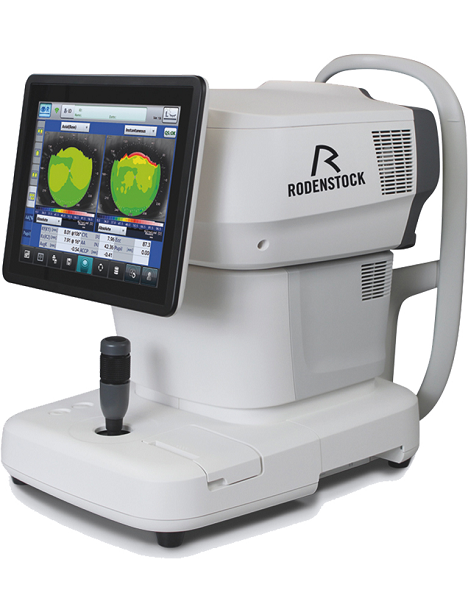
Patients presenting with cataract or IOL won’t present a challenge with the ERK-7800. In fact, now you can gather a wealth of information about natural lens opacity as well as take measurements on patients who have intraocular lens implants. | Rodenstock Alino Multifunction Refractometer
Tune-up your businessExperience 6 analyses in 1 device: Rodenstock Alino Multifunction Refractometer
Are you ready for something that is all-in-one, timesaving, space-saving and suits your business perfectly?Have a look at how powerful ALINO can be.6 in 1 solution01 RefractionHaving a good starting value for subjective refraction is essential. The QUICK REF MODE supports this even for uncooperative patients.02 KeratometryKAI (Kerato-asymmetry index) & KRI (Kerato-regularity index) give the first hint of possible irregularities on the cornea. This supports evaluation of the best vision correction or best-fitting contact lens.03 TonometryThe very gentle air puff created by a new generation of air-flow technology means that patients more readily accept the need for regular check-ups of the IOP measurement.04 PachymetryCorrecting the IOP by measuring the central corneal thickness is essential in interpreting the intraocular pressure.05 TopographyVarious topographic maps support you in carrying out vision screenings, contact lens fittings and in patient education.06 Dry EyeObserve the customers’ eye health and evaluate the long-term tolerability of contact lenses.Take advantage of the combination of tests:Additional servicesTonometry + PachymetryContact lens fitting andtolerance controlKeratometry + Topography + Dry EyeEye healthcareTopography + Tonometry + Pachymetry + Dry EyeSpecifications Rodenstock Alino Multifunction Refractometer
REFRACTIVE POWER MEASUREMENTSpherical refractive power (S) -30.00 D to + 25.00 D (at VD = 12.0 mm)Cylindrical power (C) 0.00 D to ± 12.50 D (at VD = 12.0 mm)Astigmatic axis (A) 0° to 180°KERATOMETRY MEASUREMENTCorneal curvature radius 5.00 mm to 13.00 mmCorneal astigmatic axis 0° to 180°INTRAOCULAR PRESSURE MEASUREMENTMeasurement range 1 mmHg to 60 mmHG (1 hPa to 80 hPa)PACHYMETRY MEASUREMENTMeasurement range 300 μm to 800 μmTOPOGRAPHY MEASUREMENTCorneal curvature radius 5.50 mm to 10.00 mmCorneal astigmatic axis 0° to 180°AUXILIARY FUNCTIONInterpupillary distance Measurement range: 20 mm to 85 mmCorneal diameter and pupil diameter Measurement range: 1.00 mm to 14.00 mmDry eye observation Blinking Analysis, Tear Meniscus height, Hyperemia, Meibomian glandsDATA MANAGEMENTInternal Database Integrated SD CardPrinter Integrated thermal printerData Output Type 3x USB 2.0, 1x LAN, 1x SD Card-slot, 1x WLANExport Format CSV, XML, JPG, PDFDIMENSIONS & ELECTRIC REQUIREMENTSDimensions WDH 312 × 491 × 450 mmWeight Approx. 23 kgVoltage 100 VAC to 240 VACFrequency 50/60 HzPower consumption 110 VA | New ZEISS CIRRUS 6000 – 100 kHz OCT Imaging SystemAt 100,000 scans per second, ZEISS CIRRUS 6000 enables clinicians to image a larger field of view up to 12mm in a single scan. It also captures high-defintion (HD) OCT and OCT Angiography (OCTA) scans, revealing the finer microvascular details of the retina and providing more insight into your patient’s condition. AngioPlexOCT Angiography from ZEISS ushers in a new era of eye care with non-invasive imaging of retinal microvasculature—taking glaucoma and retinal disease management and treatment planning to the next level. By offering the industry’s most comprehensive tools for assessing and analyzing a range of pathologies, ZEISS provides a complete OCT Angiography (OCTA) solution. CIRRUS 6000 is the latest addition to an already robust portfolio of OCT devices that are designed to meet the needs of all types and levels of practices and/or clinicians. It offers customers high-speed and high-throughput to help manage their large patient volume faster, all while improving imaging and image quality. “This system was designed with the patient in mind, enabling doctors to continue accessing their patient data from CIRRUS devices that are crucial to effective long-term patient care,” said Jim Mazzo, Global President of Ophthalmic Devices at Carl Zeiss Meditec. “We are committed to our customers and believe this will become an essential asset to their practice.”The 100kHz speed of the CIRRUS 6000 allows clinicians to scan patients faster, with increased efficiency and improved imaging detail. Additional features include: - Wider and deeper OCT/OCTA scans with 12x12mm OCTA and B-scan depth up to 2.9mm
- HD AngioPlex scan is a new scan type that provides more detail
- New workflow protocols to aid in increasing efficiency
- Patient-friendly “Wellness report” to help educate the patient
According to retina and vitreoretinal physician and surgeon Gregg T. Kokame, MD, of Retina Consultants of Hawaii, the new ZEISS CIRRUS 6000 is extremely fast and impressive. “With the new scan acquisition time of 100,000 per second I can scan and assess my patients much quicker, giving me the details I need with every image,” says Kokame.“ZEISS is dedicated to advancing eye care through development of new and innovative solutions, like the CIRRUS 6000,” said Dr. Ludwin Monz, President and CEO of Carl Zeiss Meditec AG. “With our comprehensive diagnostics portfolio, we will continue to create better vision standards to benefit patients today and in the future.” |




Reviews
There are no reviews yet.