| Description | CIRRUS 4000 delivers high-speed image capture with HD imaging detail and a wider field of view so you can make more informed decisions and spend more time with the patients who need it. | The new tri-functional Autorefractor Keratometer Topcon KR-8000PA Supra combines an autorefractor, an autokeratometer, and a computerized color corneal mapping system all in a single, compact unit! This enables the instrument to provide three times the diagnostic capabilities in one-third the space, at a fraction of the cost of the individual instruments. | Ezer ERK-7800 Auto Refractor/KeratometerConfidently measure the human eye with a sophisticated cutting edge technology designed to enhance your ability to diagnose ocular errors faster, easier, and accurately. Ezers ERK-7800 is brilliantly designed technology measures the eye with ultra precision and speed to provide reliable data as the starting point of your refraction and contact lens fitting. It’s compact and modern design enables seamless operation and an enhanced patient comfort, making it the ideal choice in for any ophthalmic practice. Backed by an industry leading 2-years warranty! | The image can then be displayed on a monitor, helping you to educate your patients The HRK can provide peripheral keratometry measurement data which is very useful when fitting contact lenses. The eye can be displayed in full colour mode on a tilting touch screen which enables you to see the patient’s contact lens fitting status, previously only possible using a slit lamp. As the HRK has the world’s first contact lens fitting function in an auto keratometer, you can now see the flourescein liquid with blue illumination along with automatic calculation and recommendation for contact lens fitting. | Experience 6 analyses in 1 device: refraction, keratometry, topography, tonometry, pachymetry and dry eye analysis. | Confidently measure the human eye with a sophisticated cutting edge technology designed to enhance your ability to diagnose ocular errors faster, easier, and accurately. Ezers ERK-7800 is brilliantly designed technology measures the eye with ultra precision and speed to provide reliable data as the starting point of your refraction and contact lens fitting. It’s compact and modern design enables seamless operation and an enhanced patient comfort, making it the ideal choice in for any ophthalmic practice. Backed by an industry leading 2-years warranty! |
| Content | Carl Zeiss Cirrus HD-OCT 4000
The Cirrus HD-OCT is a non-contact, high resolution tomographic and biomicroscopic imaging device. It is indicated for in-vivo viewing, axial cross-sectional, and three-dimensional imaging and measurement of anterior and posterior ocular structures, including cornea, retina, retinal nerve fiber layer, ganglion cell plus inner plexiform layer, macula, and optic nerve head. The Cirrus normative databases are quantitative tools for the comparison of retinal nerve fiber layer thickness, macular thickness, ganglion cell plus inner plexiform layer thickness, and optic nerve head measurements to a database of normal subjects. The Cirrus HD-OCT is intended for use as a diagnostic device to aid in the detection and management of ocular diseases including, but not limited to, macular holes, cystoid macular edema, diabetic retinopathy, age-related macular degeneration, and glaucoma.The ZEISS Certified Factory Direct Cirrus 4000 HD-OCT also includes the full Accessory Kit
External Fixation Light
Test Eye
Mini Keyboard
Optical Mouse
Dust Cover
Metric 5A/250v Fuse
14 Ft. CAT 5e Network Cable
USB Cable
IEC 320 to NEMA 12 inch Power Cable
IEC 320 39in. Power Cable
Install Disc including Roxio Basic
Symbol Sheet
OCT Primer Guide
Quick Start GuideHD-OCT ImagingMethodology: Spectral Domain OCT
Optical Source: superluminescent diode (SLD), 840 nm
Optical Power: < 725 μW at the cornea
Scan Speed: 27,000 A-scans per second
A-Scan depth: 2.0 mm (in tissue), 1024 points
Axial resolution: 5 μm (in tissue)
Transverse resolution: 15 μm (in tissue)Zeiss Cirrus HD-OCT 4000 OCT Spectral Domain OCT HD Fundus ImagingMethodology: Line scanning ophthalmoscope
Live Fundus Image: During alignment and during OCT scan
Optical Source: Superluminescent diode (SLD), 750 nm
Optical Power: < 1.5 mW at the cornea
Field of View: 36 degrees W x 30 degrees H
Frame rate: >20 Hz
Transverse resolution: 25 μm (in tissue)Carl Zeiss Cirrus HD-OCT 4000 Iris ImagingMethodology: CCD Camera
Resolution: 1280 x 1024
Live iris image: During alignmentElectrical, Physical and EnvironmentalWeight: 38kg (83 lbs)
Dimensions: 65L x 44W x 53H (cm)
Fixation: Internal, external
Internal fixation focus adjustment: -20D to +20D (diopters)
Input devices: Keyboard, mouse
Electrical rating (115V) Single Phase, 100/120V~ systems:50-60Hz, 5A
Fuse rating (115V) T 5A 250V
Electrical rating (230V) Single Phase, 220/240V~ systems:50-60 Hz, 2.5A
Fuse rating (230V) Fuse rating: T 5A 250V
Convenience Receptacle output ratings 115V~, 0.5 A Max, 50-60 Hz
Temperature (transport and storage) -40º to +70º C
Relative humidity (transport and storage) 10% to 100%, including condensation
Atmospheric pressure (transport and storage): 500 hPa to 1060 hPa
Temperature (operation) +10º to +35º C
Relative humidity (operation) 30% to 75%, excluding condensation
Atmospheric Pressure (operation) 700 hPa to 1060 hPa | Topcon KR8000PA Autorefractor KeratometerBy implementing Topcon’s Autorefractor Keratometer Topcon KR-8000PA Supraexclusive rotary prism technology for the refraction portion of the measurement, the Autorefractor Keratometer Topcon KR-8000PA Supra provides objective data that is unmatched in accuracy and reliability. Auto tracking and auto measurement enhance the ease of operation. The Autorefractor Keratometer Topcon KR-8000PA Supra unit also incorporates ten placido rings for enhanced testing precision, providing corneal mapping measurements out to 10mm! |
Features for Autorefractor Keratometer Topcon KR-8000PA SupraTopcon Color Mapping 32 SoftwareThis versatile 32-bit color mapping software system enhances clinical evaluations with the output of highly accurate, full color corneal maps. The system offers an enlarged color map, tangential axial maps, sagittal maps, refractive and keratometric data, and peripheral keratometric maps. It provides early phase detection of subclinical keratoconus as well as pre and post-op evaluation. The software also features a new image overlay function, as well as a Multi-Map and Difference Map View, which display multiple image maps for easy comparison. The color mapping system is an excellent patient education tool and is designed for use with the Topcon KR-7000P or KR-8000PA Auto Refractor/Keratometer. Windows® 95/98/NT Compatible.
The color mapping software also features a contact lens fitting module with adjustable parameters to view the contact lens fit on screen.The Autorefractor Keratometer Topcon KR-8000PA Supra System Benefits Include:Topcon KR8000PA Autorefractor Keratometer- Allows Three Functions at One Station:
– Refraction
– Keratometry
– Corneal Mapping
- Contact Lens Fitting Utility
- Early Phase Detection of Subclinical Keratoconus
- Direct Link to CV System
The new tri-functional Autorefractor Keratometer Topcon KR-8000PA Supra combines an autorefractor, an autokeratometer, and a computerized color corneal mapping system all in a single, compact unit! This enables the instrument to provide three times the diagnostic capabilities in one-third the space, at a fraction of the cost of the individual instruments. | Ezer ERK-7800 Autorefractor KeratometerFeatures of the ERK-7800 Auto Refractor/Keratometer
 Auto Refractor/Keratometer
Enhanced Retro-illumination Imaging
Accurate Measurement of Iris & Pupils Diameters
Precise Temperature Sensor Compensation
Enhanced Measuring Speed
Comfortable Motorized Chin Rest
Automatic High Speed Cutting Printer
Simple One Touch Lock Knob
20 Touch & Tilt Color Monitor Display
Sophisticated TFT LCD Graphic User Interface
Easy Network Capability
Backed by an Industry Leading 2-years Warranty!
Auto Refractor/Keratometer
The ERK-7800 instantly reports the patient’s assessed eye power by combining the Auto Refractor/Keratometer functions into this one sharp instrument, making measurement a snap. This determines the refractive and keratometric properties of the human eye to assist eye care professionals in the process of prescribing corrective eyeglasses and contact lenses. Keratometry and Refractometry (RK Mode) Enhanced Retro-illumination Imaging Ezer ERK-7800 Autorefractor Keratometer
With the Enhanced Retro-illumination Imaging capability in the ERK-7800, you can treat and see abnormal crystalline lenses, cataracts, and scratches of corneas helping you to determine how healthy the patients eyes are with better clarity. This allows for observation of the eye condition of the cataract or contact lens surface. The system saves up to 2 images of each eye. Accurate Measurement of Iris & Pupils Diameters
The corneal diameter and base curve of contact lenses can be measured with this one instrument. Therefore, measurements of eye and prescriptions for glasses and contact lenses can be made more efficiently. Measuring Cornea Size (SIZE MODE) Wide Dioptric Measurement Range
Because the ERK-7800 covers a wide measurement range from -25D to +22D, even an examinee with strong myopia can be measured.
Enhanced Measuring Speed
Specially designed image chips have succeeded to make REF measuring speed faster reducing the overall examination time and increases throughput for complete examinations. Comfortable Motorized Chin Rest
Simply by pressing up/down buttons, user can set the height of measuring point comfortably. With the cutting edge auto sensor mechanism, you can track down, measure and focus the eye with out ever making a mistake. Automatic Printer Paper Cut
The printer is designed to execute, print, & cut data automatically at high speed for immediate results. Simple One Touch Lock Knob
With just the touch of a single button, the main body can easily be locked to its base. 20 Degrees Tilted LCD Monitor
The LCD Monitor tilts up to 20 degrees; a design made for comfort making. Excellent ergonomics makes it possible to operate the ERK-7800 while standing or sitting, for added convenience. Sophisticated TFT LCD Graphic User Interface
Sharp images with easy to understand icons make this 6.4-inch color TFT LCD interface user-friendly and enjoyable to work with. Auto Refractor/Keratometer
Enhanced Retro-illumination Imaging
Accurate Measurement of Iris & Pupils Diameters
Precise Temperature Sensor Compensation
Enhanced Measuring Speed
Comfortable Motorized Chin Rest
Automatic High Speed Cutting Printer
Simple One Touch Lock Knob
20 Touch & Tilt Color Monitor Display
Sophisticated TFT LCD Graphic User Interface
Easy Network Capability
Backed by an Industry Leading 2-years Warranty!
Auto Refractor/Keratometer
The ERK-7800 instantly reports the patient’s assessed eye power by combining the Auto Refractor/Keratometer functions into this one sharp instrument, making measurement a snap. This determines the refractive and keratometric properties of the human eye to assist eye care professionals in the process of prescribing corrective eyeglasses and contact lenses. Keratometry and Refractometry (RK Mode) Enhanced Retro-illumination Imaging Ezer ERK-7800 Autorefractor Keratometer
With the Enhanced Retro-illumination Imaging capability in the ERK-7800, you can treat and see abnormal crystalline lenses, cataracts, and scratches of corneas helping you to determine how healthy the patients eyes are with better clarity. This allows for observation of the eye condition of the cataract or contact lens surface. The system saves up to 2 images of each eye. Accurate Measurement of Iris & Pupils Diameters
The corneal diameter and base curve of contact lenses can be measured with this one instrument. Therefore, measurements of eye and prescriptions for glasses and contact lenses can be made more efficiently. Measuring Cornea Size (SIZE MODE) Wide Dioptric Measurement Range
Because the ERK-7800 covers a wide measurement range from -25D to +22D, even an examinee with strong myopia can be measured.
Enhanced Measuring Speed
Specially designed image chips have succeeded to make REF measuring speed faster reducing the overall examination time and increases throughput for complete examinations. Comfortable Motorized Chin Rest
Simply by pressing up/down buttons, user can set the height of measuring point comfortably. With the cutting edge auto sensor mechanism, you can track down, measure and focus the eye with out ever making a mistake. Automatic Printer Paper Cut
The printer is designed to execute, print, & cut data automatically at high speed for immediate results. Simple One Touch Lock Knob
With just the touch of a single button, the main body can easily be locked to its base. 20 Degrees Tilted LCD Monitor
The LCD Monitor tilts up to 20 degrees; a design made for comfort making. Excellent ergonomics makes it possible to operate the ERK-7800 while standing or sitting, for added convenience. Sophisticated TFT LCD Graphic User Interface
Sharp images with easy to understand icons make this 6.4-inch color TFT LCD interface user-friendly and enjoyable to work with. | Huvitz HRK-8000A Auto Refractor KeratometerHuvitz Auto Ref – Keratometer HRK-8000A- Touch and tilting 7″ LCD Screen that allows for free and smooth tilting for viewing at any angle.
- Optimized Optical System
- Micro Lens Array
- Aberration Measurement which also can be displayed in a graphical Zernike Refraction Map
- PSF & Image Simulation
- Colour View Mode
- Peripheral Keratometry Measurement
- Ultra High Precision KER Data
- Contact Lens Fitting Assistance Guide
- Contact Lens Prescription Guide
- Auto Tracking
- Animated Guide
- Faster Measurement Speed
- Quiet and speedy auto cutting printer
- More data on aberration measurement
With its extreme precision and accuracy, the HRK8000A uses the most advanced wavefront technology to measure the light reflected from the retina and helps you to diagnose any refractive error. With a micro lens array developed by Huvitz, the HRK creates a number of focal points, the pattern of which can give a valuable insight into the patients ocular system. The HRK not only displays the conventional data such as spherical, cylinder and axis, the high order aberration data is displayed in a graphical Zernike refractive map, giving you a deeper understanding of your patient’s eyes.Optimized Optical System Huvitz HRK-8000A Auto Refractor Keratometer
A wavefront is a physical representation of the optical quality of a light beam. Using various methods, aberrometers map how light rays travel through the eye. The HR-8000A is engineered according to the Hartmann-Shack wavefront measurement technique, which is widely preferred for its speed and repeatability.Touch & Tilting Color Display Screen
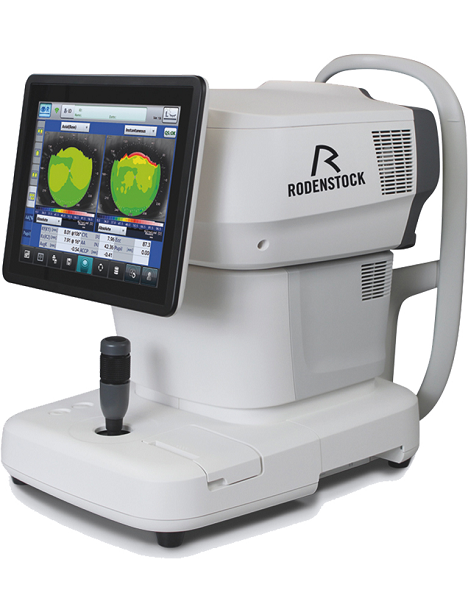
A bright, high contrast 7″ VGA color TFT LCD screen provides high resolution video images. A smooth, free tilting function also offers you a comfortable and clear view at any angle.The image can then be displayed on a monitor, helping you to educate your patients The HRK can provide peripheral keratometry measurement data which is very useful when fitting contact lenses. The eye can be displayed in full colour mode on a tilting touch screen which enables you to see the patient’s contact lens fitting status, previously only possible using a slit lamp. As the HRK has the world’s first contact lens fitting function in an auto keratometer, you can now see the flourescein liquid with blue illumination along with automatic calculation and recommendation for contact lens fitting. | Rodenstock Alino Multifunction Refractometer
Tune-up your businessExperience 6 analyses in 1 device: Rodenstock Alino Multifunction Refractometer
Are you ready for something that is all-in-one, timesaving, space-saving and suits your business perfectly?Have a look at how powerful ALINO can be.6 in 1 solution01 RefractionHaving a good starting value for subjective refraction is essential. The QUICK REF MODE supports this even for uncooperative patients.02 KeratometryKAI (Kerato-asymmetry index) & KRI (Kerato-regularity index) give the first hint of possible irregularities on the cornea. This supports evaluation of the best vision correction or best-fitting contact lens.03 TonometryThe very gentle air puff created by a new generation of air-flow technology means that patients more readily accept the need for regular check-ups of the IOP measurement.04 PachymetryCorrecting the IOP by measuring the central corneal thickness is essential in interpreting the intraocular pressure.05 TopographyVarious topographic maps support you in carrying out vision screenings, contact lens fittings and in patient education.06 Dry EyeObserve the customers’ eye health and evaluate the long-term tolerability of contact lenses.Take advantage of the combination of tests:Additional servicesTonometry + PachymetryContact lens fitting andtolerance controlKeratometry + Topography + Dry EyeEye healthcareTopography + Tonometry + Pachymetry + Dry EyeSpecifications Rodenstock Alino Multifunction Refractometer
REFRACTIVE POWER MEASUREMENTSpherical refractive power (S) -30.00 D to + 25.00 D (at VD = 12.0 mm)Cylindrical power (C) 0.00 D to ± 12.50 D (at VD = 12.0 mm)Astigmatic axis (A) 0° to 180°KERATOMETRY MEASUREMENTCorneal curvature radius 5.00 mm to 13.00 mmCorneal astigmatic axis 0° to 180°INTRAOCULAR PRESSURE MEASUREMENTMeasurement range 1 mmHg to 60 mmHG (1 hPa to 80 hPa)PACHYMETRY MEASUREMENTMeasurement range 300 μm to 800 μmTOPOGRAPHY MEASUREMENTCorneal curvature radius 5.50 mm to 10.00 mmCorneal astigmatic axis 0° to 180°AUXILIARY FUNCTIONInterpupillary distance Measurement range: 20 mm to 85 mmCorneal diameter and pupil diameter Measurement range: 1.00 mm to 14.00 mmDry eye observation Blinking Analysis, Tear Meniscus height, Hyperemia, Meibomian glandsDATA MANAGEMENTInternal Database Integrated SD CardPrinter Integrated thermal printerData Output Type 3x USB 2.0, 1x LAN, 1x SD Card-slot, 1x WLANExport Format CSV, XML, JPG, PDFDIMENSIONS & ELECTRIC REQUIREMENTSDimensions WDH 312 × 491 × 450 mmWeight Approx. 23 kgVoltage 100 VAC to 240 VACFrequency 50/60 HzPower consumption 110 VA | Ezer ERK-9000 Ezer Autorefractor KeratometerThe ERK-9000 offers your staff the opportunity to gather a wealth of precise information about the patient in one fast and easy test, making the remainder of your exam swift, simple and exact. In addition to the wealth of functions you’d expect from a top-of-the-line autorefractor/keratometer, the ERK-9000 features auto-shoot programming, an illumination mode, IOL mode and so much more.
Features:– Auto Refractor/Keratometer
– Auto-Shoot Programming
– Simple and Convenient User Environment
– IOL Mode
– Illumination Mode
– Easy Network Capability
– Wide Dioptric Measurement Range
– Accurate Iris and Pupil Measurement
– Ergonomic Joystick
– Motorized Chin Rest
– High-Speed Printer with Auto Paper Cut
– 2-Year WarrantyIncludes:Ezer ERK-9000 Ezer Autorefractor Keratometer– Power Supply Cable
– Model Eye ( S-5.0D or 5.12D or 5.25D, VD=12mm, R–7.95 )
– 2 rolls Printing Paper( Thermal Paper, Size : 57 X 50 mm )
– Dust cover ( Vinyl Cover: Use for long-term storage to prevent dust pollution )
– Operation ManualThe ERK-9000 combines all of the necessary visual pre-testing functions in one smartly designed instrument. Operators can perform refractometry and keratometry alone or simultaneously. The ERK-9000 is also quick. In fact, not even the unwanted effects of patient accommodation will stand in your way thanks to the unit’s valuable built-in auto-fogging mechanism.Auto-Shoot Programming
Users can program the ERK-9000 to shoot at their preferred mode. One click on the joystick button can take a single measurement, three continuous measurements or five continuous measurements.Simple and Convenient User Environment
The ERK-9000 features a user-friendly dashboard view. Sharp images with easy-to-understand icons make this 7.0-inch color TFT color touch screen LCD interface enjoyable to work with.
IOLMode
Patients presenting with cataract or IOL won’t present a challenge with the ERK-7800. In fact, now you can gather a wealth of information about natural lens opacity as well as take measurements on patients who have intraocular lens implants. |




Reviews
There are no reviews yet.