| Description | The OPD-Scan III is an automated 5 in 1 instrument that combines topography, wavefront, autorefraction, keratometry, and pupillometry — allowing accurate and reliable analysis of corneal aberration. | The Auto “Refkeratometer” RC-800 is the latest in economical, user-friendly, highly accurate auto “refkeratometry”. The RC-800 provides simple, easy measurement by the operator at an economical cost, without compromising accuracy or reliability. | Experience 6 analyses in 1 device: refraction, keratometry, topography, tonometry, pachymetry and dry eye analysis. | Combination of auto and manual analysesAll three manual analysis methods can be performed on the same image and also on auto-analyzed images. The versatility of combining automated and manual analyses allows analysis of the range of pathology in a comprehensive practice.
The CEM-530 with new advanced software and enhanced image capture system allows rapid image acquisition. | Ezer ERK-7800 Auto Refractor/KeratometerConfidently measure the human eye with a sophisticated cutting edge technology designed to enhance your ability to diagnose ocular errors faster, easier, and accurately. Ezers ERK-7800 is brilliantly designed technology measures the eye with ultra precision and speed to provide reliable data as the starting point of your refraction and contact lens fitting. It’s compact and modern design enables seamless operation and an enhanced patient comfort, making it the ideal choice in for any ophthalmic practice. Backed by an industry leading 2-years warranty! | The Tomey RC-5000 has highly accurate measurement combined with short examination time and ease of use, makes working with the Tomey RC-5000 Autorefractor Keratometer both professional and quick. The advanced touch-screen display allows you to perform both refraction and keratometry automatically with one simple movement, capture one eye on the display and the Tomey RC-5000 will do both eyes automatically. With the new features, the Tomey RC-5000 Autorefractor Keratometer will surely make your office more efficient. |
| Content | Nidek OPD-Scan III Corneal AnalyzerComprehensive vision analysis
OPD-Scan III VS is a device that mainly measures corneal shape (topographer) and refractive error (refractometer).
It clarifies causes of vision difficulties through wavefront analysis of information measured over a wide area.
Solutions for face-to-face consultingTablet viewer provides four kinds of easy-to-understand reports for explanation and consulting.
*The tablet is not included or sold with the OPD-Scan III VS.
Basic information reportBasic information to generally judge the patient’s eye conditions.
Topography reportIntuitive maps and numerical data for comprehending the corneal surface.
Simulation reportVisual performance simulations and MTF graphs for a variety of conditions.
Eye diagram image reportEye model to visually understand eye conditions ranging from eye fundus to cornea.
Wide range of display patterns
  Placido image
 Axial map (Additional indication)
 Visual Acuity map (Image charts)
Features Nidek OPD-Scan III Corneal Analyzer- Five-in-One true refractive workstation for all practitioners
- Overview summary for optimal clinical decisions
- A number of summaries
- Wider measurement area
- Greater topography resolution, blue placido rings
The OPD-Scan lll is the Five-in-One true refractive workstation combining - Wavefront Aberrometer
- Topographer
- Auto Refractometer
- Auto Keratometer
- Pupillometer and Pupillographer
- Irregularity helps determine the best strategy for vision correction. Separation into Total, Corneal and Internal components allows determination of the source of the optical pathology.
- PSF images of OPD, Axial, and Internal OPD map simulate objective retinal visual quality from each component of the eye for easy clinical assessment and patient education.
- Corneal Spherical Aberration aids in the selection of aspheric IOLs and contact lenses.
- Color coded Classification Indices help identify post-LASIK corneas and Keratoconus.
- The Astigmatism index aids the implantation of toric IOLs such as incision placement and lens alignment.
- A retroillumination image of cataracts captured during the OPD exam allows better understanding of pupillary effects on vision and in patient education.
| Tomey RC-800 Auto Refractor Keratometer
Refractometry: Simple handling of the fine adjustment and measurement by yourself. Fogging is applied automatically for each measurement for more accurate results.Keratometry: Short consecutive measurements and time provide reliable data. Measurements at φ3.0mm (R = 8.0mm) give you enough information for contact lens fitting.Diameter Measurement of Cornea and Pupil: Easy measurement by moving the two cursors on the display to the boundaries of Cornea or Pupil.Language Selection: RC-800 has a Multi-language function. You can select your required language from “English”, “Japanese”, “German”, “Chinese”, “Spanish”, “Spanish Latin America”, “Italian”, “Portuguese”, “French” and “Russian”.Features:• Highly Accurate
• Simple to Use
• Diameter Measurement of Cornea and Pupil
• High Speed Printer
• Auto Shot
• Color Touch Screen
• USB connection
• Large Patient Database
• Easy Database Operation
• Multi-Language Operation
• Fourier Refractive Analysis
• Quick Data Reference
• Built-in LCD Alignment
• Keratoconus Screening & Other ApplicationsMeasurement Ranges:Refraction:• Sphere: -25.00D to +22.00D (VD=12.0mm)
• Cylinder: 0D to ±10.00D (VD=12.0mm)
• Axis: 0° to 180°
• Minimum Pupil Dia: Ø2.0mm
• Measurement time: 0.2 second/single eye (data taking time)Keratometry:• Range: 5.00mm to 11.00mm
• Corneal Refraction: 30.68D to 67.50D (n=1.3375)
• Corneal Astigmatism: 0D to 10D (n=1.3375)
• Axis: 0° to 180°
• Measurement area: Ø3mm (at 8.00mm corneal curvature)
• Measurement time: 0.1 second/single eye (data taking time)Other features:Tomey RC-800 Auto Refractor Keratometer• PD Measurement range 50 to 86mm
• Corneal diameter measurement
• Measurement range: 10.0 to 14.0mm
• Display unit: 0.1mm
• Pupil diameter measurement
• Measurement range: 1.0 to 10.0 mm
• Display unit: 0.1mm
• Built-in Printer Thermal printer
• Data output type RS232C / USB-D
• Display 5.7 inch color liquid crystal display
• Dimensions and weight 297(W)x 500(D) x 448(H)mm
• Approx. 17kg
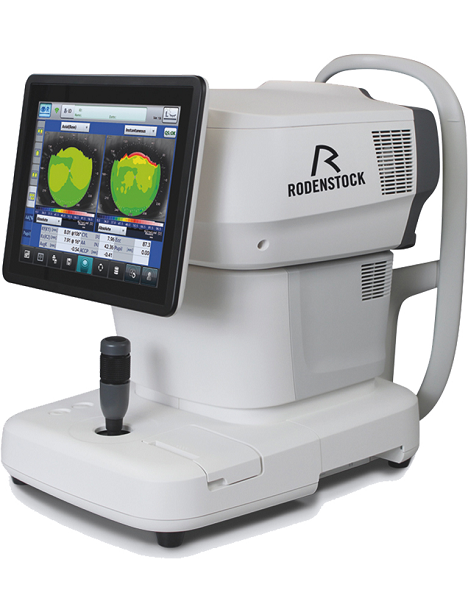
• Power Requirements AC 100V to 240V, 50 / 60 Hz, 80VA to 100VAThe Auto “Refkeratometer” RC-800 is the latest in economical, user-friendly, highly accurate auto “refkeratometry”. The RC-800 provides simple, easy measurement by the operator at an economical cost, without compromising accuracy or reliability. | Rodenstock Alino Multifunction Refractometer
Tune-up your businessExperience 6 analyses in 1 device: Rodenstock Alino Multifunction Refractometer
Are you ready for something that is all-in-one, timesaving, space-saving and suits your business perfectly?Have a look at how powerful ALINO can be.6 in 1 solution01 RefractionHaving a good starting value for subjective refraction is essential. The QUICK REF MODE supports this even for uncooperative patients.02 KeratometryKAI (Kerato-asymmetry index) & KRI (Kerato-regularity index) give the first hint of possible irregularities on the cornea. This supports evaluation of the best vision correction or best-fitting contact lens.03 TonometryThe very gentle air puff created by a new generation of air-flow technology means that patients more readily accept the need for regular check-ups of the IOP measurement.04 PachymetryCorrecting the IOP by measuring the central corneal thickness is essential in interpreting the intraocular pressure.05 TopographyVarious topographic maps support you in carrying out vision screenings, contact lens fittings and in patient education.06 Dry EyeObserve the customers’ eye health and evaluate the long-term tolerability of contact lenses.Take advantage of the combination of tests:Additional servicesTonometry + PachymetryContact lens fitting andtolerance controlKeratometry + Topography + Dry EyeEye healthcareTopography + Tonometry + Pachymetry + Dry EyeSpecifications Rodenstock Alino Multifunction Refractometer
REFRACTIVE POWER MEASUREMENTSpherical refractive power (S) -30.00 D to + 25.00 D (at VD = 12.0 mm)Cylindrical power (C) 0.00 D to ± 12.50 D (at VD = 12.0 mm)Astigmatic axis (A) 0° to 180°KERATOMETRY MEASUREMENTCorneal curvature radius 5.00 mm to 13.00 mmCorneal astigmatic axis 0° to 180°INTRAOCULAR PRESSURE MEASUREMENTMeasurement range 1 mmHg to 60 mmHG (1 hPa to 80 hPa)PACHYMETRY MEASUREMENTMeasurement range 300 μm to 800 μmTOPOGRAPHY MEASUREMENTCorneal curvature radius 5.50 mm to 10.00 mmCorneal astigmatic axis 0° to 180°AUXILIARY FUNCTIONInterpupillary distance Measurement range: 20 mm to 85 mmCorneal diameter and pupil diameter Measurement range: 1.00 mm to 14.00 mmDry eye observation Blinking Analysis, Tear Meniscus height, Hyperemia, Meibomian glandsDATA MANAGEMENTInternal Database Integrated SD CardPrinter Integrated thermal printerData Output Type 3x USB 2.0, 1x LAN, 1x SD Card-slot, 1x WLANExport Format CSV, XML, JPG, PDFDIMENSIONS & ELECTRIC REQUIREMENTSDimensions WDH 312 × 491 × 450 mmWeight Approx. 23 kgVoltage 100 VAC to 240 VACFrequency 50/60 HzPower consumption 110 VA | Nidek CEM-530 Specular Microscope
The analysis results with graphic and color-coded cell images helps the clinician to rapidly and effectively evaluate the endothelial cell layer.In addition to conventional central and peripheral specular microscopy, the CEM-530 includes a unique function to capture paracentral images.- Paracentral specular microscopy
- Faster measurements and two-second auto analysis
- Comprehensive analysis
- Advanced manual analysis functions
- Easy operation
- Additional features with CEM Viewer for NAVIS-EX
Combination of auto and manual analysesAll three manual analysis methods can be performed on the same image and also on auto-analyzed images. The versatility of combining automated and manual analyses allows analysis of the range of pathology in a comprehensive practice. Features- Multi area specular microscopy
- Enhanced usability and quick analysis
- Advanced manual analysis functions
- Combination of auto and manual analyses
- Additional features with CEM Viewer for NAVIS-EX
Multi area specular microscopyIn addition to conventional central and peripheral specular microscopy, the CEM-530 includes a NIDEK original function that captures paracentral images. The combination of central, paracentral, and peripheral imaging provides a broader, overall view that can be used for detailed morphological and quantitative evaluation of the endothelial layer and individual cells.
Enhanced usability and quick analysis
The 3D auto tracking and auto shot functions result in a user friendly and patient friendly experience.
Data analysis within 2 seconds allows efficient patient flow.
 Detail analysis
Advanced manual analysis functions
Center point
Select the approximate center of a cell. The cells are detected based on the surrounding points. This method is effective for areas where groups of cells are clumped together.
Corner point
Trace the outlines of the cells to be analyzed by selecting the corners of each cell. This method is suitable for detailed identification of the size and dimension of isolated cells.
Pattern select
Select a hexagonal reference pattern that is similar to the cell size and drag it onto the cell to be analyzed. This method is effective for rough identification of the size and dimension of the cells.
Combination of auto and manual analyses All three manual analysis methods can be performed on the same image and on auto-analyzed images. The versatility of combining automated and manual analysis on the same image allows for better clinical interpretation of the diverse range of pathology in a comprehensive practice.
Additional features with CEM Viewer for NAVIS-EX* (optional)
CEM Viewer is software used for viewing and working with CEM-530 data via NAVIS-EX. This function enhances the capability of the CEM-530 with additional features and increases the efficiency of any clinic.
*NAVIS-EX is optional software and is required for use of the CEM Viewer.
Data management and endothelial cell count
Unlimited NAVIS-EX database is available for review on the CEM Viewer. The basic functions of the CEM-530 such as endothelial cell count are available on the CEM Viewer.
Progression follow-up and comparison
Multiple examination data sets are displayed in chronological order for follow-up. Additionally, two data sets are displayed for comparison. Endothelial changes can be monitored over time with this function.
Paracentral display with peripheralThe images and analyses of the paracentral and peripheral areas are displayed providing a comprehensive image of endothelial cells. | Ezer ERK-7800 Autorefractor KeratometerFeatures of the ERK-7800 Auto Refractor/Keratometer
 Auto Refractor/Keratometer
Enhanced Retro-illumination Imaging
Accurate Measurement of Iris & Pupils Diameters
Precise Temperature Sensor Compensation
Enhanced Measuring Speed
Comfortable Motorized Chin Rest
Automatic High Speed Cutting Printer
Simple One Touch Lock Knob
20 Touch & Tilt Color Monitor Display
Sophisticated TFT LCD Graphic User Interface
Easy Network Capability
Backed by an Industry Leading 2-years Warranty!
Auto Refractor/Keratometer
The ERK-7800 instantly reports the patient’s assessed eye power by combining the Auto Refractor/Keratometer functions into this one sharp instrument, making measurement a snap. This determines the refractive and keratometric properties of the human eye to assist eye care professionals in the process of prescribing corrective eyeglasses and contact lenses. Keratometry and Refractometry (RK Mode) Enhanced Retro-illumination Imaging Ezer ERK-7800 Autorefractor Keratometer
With the Enhanced Retro-illumination Imaging capability in the ERK-7800, you can treat and see abnormal crystalline lenses, cataracts, and scratches of corneas helping you to determine how healthy the patients eyes are with better clarity. This allows for observation of the eye condition of the cataract or contact lens surface. The system saves up to 2 images of each eye. Accurate Measurement of Iris & Pupils Diameters
The corneal diameter and base curve of contact lenses can be measured with this one instrument. Therefore, measurements of eye and prescriptions for glasses and contact lenses can be made more efficiently. Measuring Cornea Size (SIZE MODE) Wide Dioptric Measurement Range
Because the ERK-7800 covers a wide measurement range from -25D to +22D, even an examinee with strong myopia can be measured.
Enhanced Measuring Speed
Specially designed image chips have succeeded to make REF measuring speed faster reducing the overall examination time and increases throughput for complete examinations. Comfortable Motorized Chin Rest
Simply by pressing up/down buttons, user can set the height of measuring point comfortably. With the cutting edge auto sensor mechanism, you can track down, measure and focus the eye with out ever making a mistake. Automatic Printer Paper Cut
The printer is designed to execute, print, & cut data automatically at high speed for immediate results. Simple One Touch Lock Knob
With just the touch of a single button, the main body can easily be locked to its base. 20 Degrees Tilted LCD Monitor
The LCD Monitor tilts up to 20 degrees; a design made for comfort making. Excellent ergonomics makes it possible to operate the ERK-7800 while standing or sitting, for added convenience. Sophisticated TFT LCD Graphic User Interface
Sharp images with easy to understand icons make this 6.4-inch color TFT LCD interface user-friendly and enjoyable to work with. Auto Refractor/Keratometer
Enhanced Retro-illumination Imaging
Accurate Measurement of Iris & Pupils Diameters
Precise Temperature Sensor Compensation
Enhanced Measuring Speed
Comfortable Motorized Chin Rest
Automatic High Speed Cutting Printer
Simple One Touch Lock Knob
20 Touch & Tilt Color Monitor Display
Sophisticated TFT LCD Graphic User Interface
Easy Network Capability
Backed by an Industry Leading 2-years Warranty!
Auto Refractor/Keratometer
The ERK-7800 instantly reports the patient’s assessed eye power by combining the Auto Refractor/Keratometer functions into this one sharp instrument, making measurement a snap. This determines the refractive and keratometric properties of the human eye to assist eye care professionals in the process of prescribing corrective eyeglasses and contact lenses. Keratometry and Refractometry (RK Mode) Enhanced Retro-illumination Imaging Ezer ERK-7800 Autorefractor Keratometer
With the Enhanced Retro-illumination Imaging capability in the ERK-7800, you can treat and see abnormal crystalline lenses, cataracts, and scratches of corneas helping you to determine how healthy the patients eyes are with better clarity. This allows for observation of the eye condition of the cataract or contact lens surface. The system saves up to 2 images of each eye. Accurate Measurement of Iris & Pupils Diameters
The corneal diameter and base curve of contact lenses can be measured with this one instrument. Therefore, measurements of eye and prescriptions for glasses and contact lenses can be made more efficiently. Measuring Cornea Size (SIZE MODE) Wide Dioptric Measurement Range
Because the ERK-7800 covers a wide measurement range from -25D to +22D, even an examinee with strong myopia can be measured.
Enhanced Measuring Speed
Specially designed image chips have succeeded to make REF measuring speed faster reducing the overall examination time and increases throughput for complete examinations. Comfortable Motorized Chin Rest
Simply by pressing up/down buttons, user can set the height of measuring point comfortably. With the cutting edge auto sensor mechanism, you can track down, measure and focus the eye with out ever making a mistake. Automatic Printer Paper Cut
The printer is designed to execute, print, & cut data automatically at high speed for immediate results. Simple One Touch Lock Knob
With just the touch of a single button, the main body can easily be locked to its base. 20 Degrees Tilted LCD Monitor
The LCD Monitor tilts up to 20 degrees; a design made for comfort making. Excellent ergonomics makes it possible to operate the ERK-7800 while standing or sitting, for added convenience. Sophisticated TFT LCD Graphic User Interface
Sharp images with easy to understand icons make this 6.4-inch color TFT LCD interface user-friendly and enjoyable to work with. | Tomey RC-5000 Auto Refractor Keratometer
Tomey RC-5000 RefractometryNormal Mode:-Fogging is applied automatically for each measurement for more Accurate ResultsQuick Mode:-Fogging is applied as needed for consecutive measurements.IOL/CAT Mode:-This mode is used to measure cataract or pseudophakic eyes.Keratometry:-Short consecutive measurements and time provide reliable data.
-Measurements at 6.00mm (R=8.0mm) as well as at 3.00mm give you enough information for contact lens fitting.
-base curves of contact lenses are stored, categorized and suggested manufacturers are automatically printed.Diameter Measurements of Cornea and Pupil:-Measurement can be done easily by moving the two cursors on the display to the boundary of cornea or pupil. This is useful for deciding the diameter of a contact lens and for other contact lens fitting practice.Power Joystick:-Move the joystick ring up/down and the instrument head moves up/down quickly.
-Move the joystick hand rest to the right/left or backward/forward and the instrument head moves to the right/left or backward/forward quickly.
-Rotate the joystick ring and the instrument head moves up/down slowly.
-Tilt the joystick and the instrument head moves in each direction slowly.Power Chinrest:-The chin rest can be moved by pushing the buttons on the front panel. No need to reach out to the chin rest for manual adjustments.Autorefractor Keratometer Features:Refractometory : Tomey RC-5000 Auto Refractor Keratometer-Sphere 25.00 to +22.00D (VD =12.00mm) Cylinder -10.00 to +10.00D (VD = 12.00mm)
-Axis 0 to 180 Degree
-Minimum Pupil Dia. 2.2mm
-Measurements Time 0.2 Sec.Keratometry :-Range 5.00mm to 11.00mm
-Corneal Refraction 30.68D to 67.50D (n = 1.3375)
-Corneal Astigmatism 0D to 10D (n = 1.3375)
-Axis 0 to 180 Degree
-Measured Area 3.0mm / 6.0 mm
-Measured Time 0.1 Sec PD
-Measurement Yes (50 to 86mm)
-Diameter Measuremnt of Cornea & Pupil 1.0 to 14.0mm
-Chinrest : Power Chin Rest
-Printer : High Speed Thermal Line Printer
-OutputPort RS-232C
-Power Requirements: AC 100V to 240V
-50/60Hz 130VA |




Reviews
There are no reviews yet.