| Description | Topcon KR 8800 autorefractor keratometer has been checked and certified by an authorized Topcon technician. | The Sequoia system’s advanced technologies are designed to make image acquisition easier, reduce exam time and increase overall efficiency. Along with many other included features, the Sequoia system offers Native, a patient specific imaging which adapts both phase and amplitude information of each unique patient’s properties which delivers a consistently better image across a broad range of patients. | Combination of auto and manual analysesAll three manual analysis methods can be performed on the same image and also on auto-analyzed images. The versatility of combining automated and manual analyses allows analysis of the range of pathology in a comprehensive practice.
The CEM-530 with new advanced software and enhanced image capture system allows rapid image acquisition. | Experience 6 analyses in 1 device: refraction, keratometry, topography, tonometry, pachymetry and dry eye analysis. | The Nidek RS-330 OCT is a combination of a High-Definition OCT and fundus camera. Optional delivery with FAF (Auto-fluorescence function) | New Handpiece Design The Optima – 518 Classic is the first model to use the new Mark II which enables a multipurpose handpiece:
* Faster treatments – up to 0.5 Seconds Between pulses.
* Real-time handpiece temperature control.
* Contemporary and stylish design.
* Light weight design – 25% less weight to improve the therapists’ comfort. |
| Content | Topcon KR-8800 Autorefractor Keratometer
The Topcon KR-8800 Autorefractor Keratometer features fast, easy and accurate measurements. The Topcon KR-8800 Autorefractor Keratometer also offers a 20% wider measurement range, a color LCD screen, and a 2.0mm minimum pupil diameter. Fast and accurate refraction and keratometry readings are also standard on the KR-8800, as well as a new color LCD screen. The Topcon KR-8800 Autorefractor Keratometer offers Rotary Prism measurement for enhanced accuracy. Other features offered on the Topcon KR-8800 Autorefractor Keratometer are simultaneous display of binocular readings, scenic fixation chart, USB connection for fast data transfer, and auto fire mode for fast reliable data collection.Simultaneous Display of Binocular Readings
The new color LCD monitor simultaneously displays the readings of both right and left eyes so that the operator can instantly observe all of the pertinent information.Wider Measurement Range
The new 8800 series’ wider range allows measurements to be obtained on patients with up to 10D of astigmatism.Rotary Prism Measurement System
The new 8800 series features Topcon’s exclusive Rotary Prism Technology for unmatched accuracy and reliability. The off-centered ring target is able to measure areas that may be occluded by a small diameter pupil. The prism angle enables a much wider area of the retina to be measured. As a result, the measurement image provides extremely reliable data.Faster Measurement Topcon KR-8800 Autorefractor Keratometer
The 8800 series are among the fastest auto refractors in the world. A specially designed CPU enables the 8800 series to significantly reduce the measurement time.Scenic Fixation Chart
The scenic color chart makes eye fixation easier and is adjustable in two brightness levels for optimal measuring results with either large or small pupils.Auto Measurement
As soon as the KR-8800 is properly aligned, this innovative function initiates the measurement process and completes three readings of each eye providing that proper alignment is maintained.Cornea Diameter Measurement
Corneal diameter can be measured either during testing of the patient or later by recalling the image of the cornea on the monitor. | Siemens Acuson Sequoia 512 LCD Ultrasound Machine18″ Flat panel LCD Monitor–Progressive Media & Display II Package, Cardiac/OB/Vascular Calc. Package, Signature II Option, AUX, CPS Cardiology, CPS General Cadene Trigg Burst, Calc Data to MO, Card Cadence II Contrast Quant, Cornoary Flow reserve, Dicome Store/Print, DTI (Doppler Tissue Imaging), High HR ECG, MIS/MIF, Modality Worklist Native TEQ, Native TEQ, NTHI (Native Tissue Harmonics), Spectral TEQ, TEQ (Tissue Equalization), VVIFeatures- Shared Service
- Native Patient Specific Imaging
- Four Sight TEE view
- Axius quantitative strain rate imaging
- Cadence contrast pulse sequencing technology
- Native Tissue Harmonic Imaging
- Native TEQ ultrasound technology
- Color doppler, Color angio and b-color
- PW/CW Doppler
- M-Mode
- Folding Flat Panel Display
- DICOM capabilities
Applications- Abdominal
- Breast
- OB/GYN
- Vascular
- Pediatrics
- Cardiology
- Musculoskeletal
- Neonatal
Acuson Sequoia 512 Features:- Imaging: Gray-scale 2-D, M-mode, SST Color Doppler, Solo Spectral Doppler, 3-D Surface Rendering, Native Tissue Harmonic Imaging, Auto Doppler, M-Mode, PW Doppler, Color Doppler, Color Power Doppler
- 19" color CRT monitor
- Native tissue harmonic imaging (NTHI)
- DIMAQ: image management
- Advanced vascular analysis
- Advanced spatial compounding
- Native patient specific imaging
- Mitral valve assessment
- CPS contrast pulse sequencing technology
- Clarifying vascular enhancement technology
- High resolution color flow
- Vascular, and General Imaging calculation packages
- Coherent beamformer technology/spatial compounding
- Space/time resolution control
- Cine and zoom/RES
Compatible Ultrasound Probes and Transducers:- Acuson V5Ms TEE Probe
- Acuson 4C1 Curved Array Probe
- Acuson 6C2 Curved Array Probe
- Acuson 8C4 Curved Array Probe
- Acuson 4V1 Vector Array Probe
- Acuson EV-8C4 Endocavitary Probe
- Acuson EC-10C5 Endocavitary Probe
- Acuson 6L3 Linear Array Probe
- Acuson 8L5T Intraoperative Probe
- Acuson 8L5 Linear Array Probe
- Acuson 9L4 Linear Array Probe
- Acuson 15L8 Linear Array Probe
- Acuson 17L5 Linear Array Probe
The Sequoia 512 with LCD ultrasound machine uniquely minimizes automatic image optimization time by up to 80% to make way for an easier and speedier ultrasound test time as well as allow for a more confident diagnosis each time. As a patient-specific imaging ultrasound, it has a unique matched response capacity for accurate image quality, sharp clinical specificity, and optimized diagnostic outcomes that makes infinitesimal pathologies and other anatomical detail in the most difficult-to-image patients becomes more vivid and visible. | Nidek CEM-530 Specular Microscope
The analysis results with graphic and color-coded cell images helps the clinician to rapidly and effectively evaluate the endothelial cell layer.In addition to conventional central and peripheral specular microscopy, the CEM-530 includes a unique function to capture paracentral images.- Paracentral specular microscopy
- Faster measurements and two-second auto analysis
- Comprehensive analysis
- Advanced manual analysis functions
- Easy operation
- Additional features with CEM Viewer for NAVIS-EX
Combination of auto and manual analysesAll three manual analysis methods can be performed on the same image and also on auto-analyzed images. The versatility of combining automated and manual analyses allows analysis of the range of pathology in a comprehensive practice. Features- Multi area specular microscopy
- Enhanced usability and quick analysis
- Advanced manual analysis functions
- Combination of auto and manual analyses
- Additional features with CEM Viewer for NAVIS-EX
Multi area specular microscopyIn addition to conventional central and peripheral specular microscopy, the CEM-530 includes a NIDEK original function that captures paracentral images. The combination of central, paracentral, and peripheral imaging provides a broader, overall view that can be used for detailed morphological and quantitative evaluation of the endothelial layer and individual cells.
Enhanced usability and quick analysis
The 3D auto tracking and auto shot functions result in a user friendly and patient friendly experience.
Data analysis within 2 seconds allows efficient patient flow.
  Detail analysis
Advanced manual analysis functions
Center point
Select the approximate center of a cell. The cells are detected based on the surrounding points. This method is effective for areas where groups of cells are clumped together.
Corner point
Trace the outlines of the cells to be analyzed by selecting the corners of each cell. This method is suitable for detailed identification of the size and dimension of isolated cells.
Pattern select
Select a hexagonal reference pattern that is similar to the cell size and drag it onto the cell to be analyzed. This method is effective for rough identification of the size and dimension of the cells.
Combination of auto and manual analyses All three manual analysis methods can be performed on the same image and on auto-analyzed images. The versatility of combining automated and manual analysis on the same image allows for better clinical interpretation of the diverse range of pathology in a comprehensive practice.
Additional features with CEM Viewer for NAVIS-EX* (optional)
CEM Viewer is software used for viewing and working with CEM-530 data via NAVIS-EX. This function enhances the capability of the CEM-530 with additional features and increases the efficiency of any clinic.
*NAVIS-EX is optional software and is required for use of the CEM Viewer.
Data management and endothelial cell count
Unlimited NAVIS-EX database is available for review on the CEM Viewer. The basic functions of the CEM-530 such as endothelial cell count are available on the CEM Viewer.
Progression follow-up and comparison
Multiple examination data sets are displayed in chronological order for follow-up. Additionally, two data sets are displayed for comparison. Endothelial changes can be monitored over time with this function.
Paracentral display with peripheralThe images and analyses of the paracentral and peripheral areas are displayed providing a comprehensive image of endothelial cells. | Rodenstock Alino Multifunction Refractometer
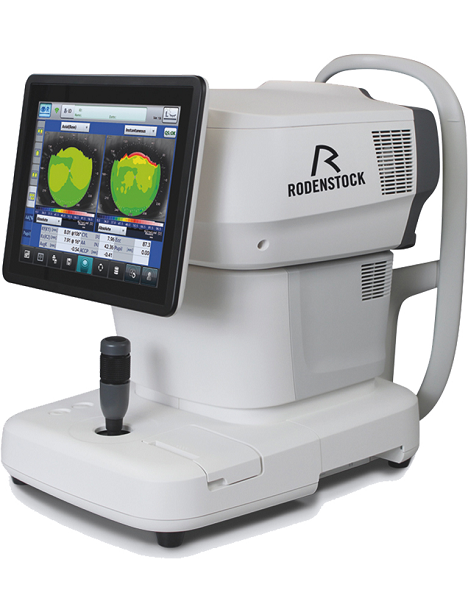
Tune-up your businessExperience 6 analyses in 1 device: Rodenstock Alino Multifunction Refractometer
Are you ready for something that is all-in-one, timesaving, space-saving and suits your business perfectly?Have a look at how powerful ALINO can be.6 in 1 solution01 RefractionHaving a good starting value for subjective refraction is essential. The QUICK REF MODE supports this even for uncooperative patients.02 KeratometryKAI (Kerato-asymmetry index) & KRI (Kerato-regularity index) give the first hint of possible irregularities on the cornea. This supports evaluation of the best vision correction or best-fitting contact lens.03 TonometryThe very gentle air puff created by a new generation of air-flow technology means that patients more readily accept the need for regular check-ups of the IOP measurement.04 PachymetryCorrecting the IOP by measuring the central corneal thickness is essential in interpreting the intraocular pressure.05 TopographyVarious topographic maps support you in carrying out vision screenings, contact lens fittings and in patient education.06 Dry EyeObserve the customers’ eye health and evaluate the long-term tolerability of contact lenses.Take advantage of the combination of tests:Additional servicesTonometry + PachymetryContact lens fitting andtolerance controlKeratometry + Topography + Dry EyeEye healthcareTopography + Tonometry + Pachymetry + Dry EyeSpecifications Rodenstock Alino Multifunction Refractometer
REFRACTIVE POWER MEASUREMENTSpherical refractive power (S) -30.00 D to + 25.00 D (at VD = 12.0 mm)Cylindrical power (C) 0.00 D to ± 12.50 D (at VD = 12.0 mm)Astigmatic axis (A) 0° to 180°KERATOMETRY MEASUREMENTCorneal curvature radius 5.00 mm to 13.00 mmCorneal astigmatic axis 0° to 180°INTRAOCULAR PRESSURE MEASUREMENTMeasurement range 1 mmHg to 60 mmHG (1 hPa to 80 hPa)PACHYMETRY MEASUREMENTMeasurement range 300 μm to 800 μmTOPOGRAPHY MEASUREMENTCorneal curvature radius 5.50 mm to 10.00 mmCorneal astigmatic axis 0° to 180°AUXILIARY FUNCTIONInterpupillary distance Measurement range: 20 mm to 85 mmCorneal diameter and pupil diameter Measurement range: 1.00 mm to 14.00 mmDry eye observation Blinking Analysis, Tear Meniscus height, Hyperemia, Meibomian glandsDATA MANAGEMENTInternal Database Integrated SD CardPrinter Integrated thermal printerData Output Type 3x USB 2.0, 1x LAN, 1x SD Card-slot, 1x WLANExport Format CSV, XML, JPG, PDFDIMENSIONS & ELECTRIC REQUIREMENTSDimensions WDH 312 × 491 × 450 mmWeight Approx. 23 kgVoltage 100 VAC to 240 VACFrequency 50/60 HzPower consumption 110 VA | Nidek RS-330 Retina Scan Duo 2 with FAFThe Retina Scan Duo 2 is a combined OCT and fundus camera system that incorporates new features enhancing screening and clinical efficiency in addition to user-friendly features that were incorporated from the previous model. FEATURES : Nidek RS-330 Retina Scan Duo 2 with FAF- Fundus image acquisition with macula and disc capture in one image on OCT
- Combined diagnosis of macular and disc pathologies
- Wide area scan (12 x 9 mm)
Wide area normative database (macula: 9 x 9 mm, disc: 6 x 6 mm): A 12 x 9 mm wide area image can be acquired. The retina map captures both the macula and disc in a single shot. The normative database provides a wide area color-coded map comparing the patient’s macular thickness to a population of normal eyes.
- Denoising technique with deep learning: A new image enhancement technique using deep learning automatically displays a denoised image once B-scan acquisition is complete. With deep learning of a large data set of images averaged from 120 images, this denoising technique provides high definition images comparable to a multiple-image-averaging technique. The denoising function generates high definition images from a single frame while decreasing image acquisition time and increasing patient comfort.
- Quick acquisition of high definition B-scan images from a single-frame image
- Fundus autofluorescence (FAF): The FAF function is an advanced screening feature that allows non-invasive evaluation of the RPE without contrast dye.
*Available for the FAF model
Nidek RS-330 Retina Scan Duo 2– Easy operation with 3-D auto tracking, auto shot, and user friendly interface
– High definition images
– Wide area scan (12 x 9 mm) / Wide area normative database (9 x 9 mm)
– Multiple OCT scan patterns
– Value added features
– Various reports
OCT images are captured at scan speeds of 70,000
A-scans/s which is 32% faster than acquisition with the
Retina Scan Duo™ using Regular OCT sensitivity* Wide area scan (12 x 9 mm)
Wide area normative database (macula: 9 x 9 mm, disc: 6 x 6 mm)
A 12 x 9 mm wide area image can be acquired. The retina
map captures both the macula and disc in a single shot.
The normative database provides a wide area color-coded
map comparing the patient’s macular thickness to a
population of normal eyes. Denoising using deep learning
A new image enhancement technique using deep learning automatically displays a denoised image once
B-scan acquisition is complete. With deep learning of a large data set of images averaged from 120 images,
this denoising technique provides high definition images comparable to a multiple-image-averaging
technique. The denoising function generates high definition images from a single frame while decreasing
image acquisition time and increasing patient comfort | Active Optical Systems Optima 518 IPL LaserHandpiece (Standard):Multipurpose Wavelength Mark-II
Handpiece (Optional):Facial Treatments
Pulse Interval/Repetition Rate:0.5 – 2 Seconds
Maximum Output Treatment Pattern:22 Joule /cm 2
Output Power:11-31 Joule / cm 2 , up to 4000 W
Cooling System:Improved Air Cooling
Control:Advanced Software Interface
Lamp’s Life Span:200,000 Flashes (minimum)
Treatment Area/Spot Size:15 x 50 mm, (7.5 cm 2)
Wavelength:420 – 1,100 nm
Weight:88.18 lbs (40Kg) (including stand)
Dimensions:17.32 inches x 17.72 inches x 39.37 inches (44cm x 45cm x 100cm)
Mains:220-230 VAC, 50/60 Hz; 100-120 VAC, 50/60 Hz
Max Mains Power:600 VA
Treatments Variety:
Skin Rejuvenation
Pigmentation Treatment
Acne Treatment
Hair Removal
Hair Removal – Deep Follicles
Hair Removal – Sensitive Skin
Vascular (Facial) Treatment
Tattoo Removal
The Laser uses 12 preset programs. The programs are set in a consecutive, energy intensity increasing order, as specified by the tables of settings, covering all types of hair and skin combinations to be treated.
12 Programs
1 – Very Dark Skin, Fitzpatrick Skin Type IV
2 – Dark Skin, Fitzpatrick Skin Type IV
3 – Dark Skin, Fitzpatrick Skin Type III
4 – Dark Skin, Fitzpatrick Skin Type III
5 – Medium Skin, Fitzpatrick Skin Type II
6 – Medium Skin, Fitzpatrick Skin Type II
7 – Light Skin, Fitzpatrick Skin Type II
8 – Light Skin, Fitzpatrick Skin Type I
9 – Very Light Skin, Fitzpatrick Skin Type I
10 – Very Light Skin, Fitzpatrick Skin Type I
11 – Very Light Skin, Fitzpatrick Skin Type I
12 – High Power, Fitzpatrick Skin Type IOptima-518-Classic Active Optical Systems Optima 518 IPL LaserThe Optima – 518 Classic was designed to answer the needs of sophisticated practitioners who want to provide state of the art treatment to their patients on one hand, based on proven and tested treatment protocols and on the other hand to have the ability to reach new and improved protocols by conducting innovative clinical investigations.The Optima – 518 Classic, based on active’s GEM-PL technology, sets the pulse pattern according to the selected treatment type, skin color, skin photosensitivity and treatment depth. The treatment protocols and different pulse patterns take into account the tissue’s TRT (Thermal Relaxation Time) and the combined knowledge accumulated from thousands of treatments done during the years and clinical investigations done to confirm the findings.New Handpiece Design The Optima – 518 Classic is the first model to use the new Mark II which enables a multipurpose handpiece:
* Faster treatments – up to 0.5 Seconds Between pulses.
* Real-time handpiece temperature control.
* Contemporary and stylish design.
* Light weight design – 25% less weight to improve the therapists’ comfort.Research program for clinical investigations, the self setting program allows researchers to set the treatment’s parameters according to their needs. Allowing advanced research with the device. The energy levels in the self setting program can reach 31J cm 2 with high intensity of 4000 W.Approvals
* CE MDD Intl. Medical Standard
* FDA U.S. Safety Standard
* ISO-13485 Med. Production STD
* IEC 60-601-1 Medical Safety STD
* CFS Gov. Health Approval
* CSA Can. & U.S. Safety App
* TGA Australian health STD. |




Reviews
There are no reviews yet.