| Description | Confidently measure the human eye with a sophisticated cutting edge technology designed to enhance your ability to diagnose ocular errors faster, easier, and accurately. Ezers ERK-7800 is brilliantly designed technology measures the eye with ultra precision and speed to provide reliable data as the starting point of your refraction and contact lens fitting. It’s compact and modern design enables seamless operation and an enhanced patient comfort, making it the ideal choice in for any ophthalmic practice. Backed by an industry leading 2-years warranty! | The impression scan can be applied directly in 3Shape DentalDesigner
like any gypsum model scan and sets new standards for system
applicability. In combination with DentalDesigner the new D500
scanner brings unprecedented scan-to completed design time to the
market for digital dentistry. attractive opportunities in terms of
manufacturing cost, model creation speed and quality. | CIRRUS 4000 delivers high-speed image capture with HD imaging detail and a wider field of view so you can make more informed decisions and spend more time with the patients who need it. | workflow, because some letters inspire confidence.With Neksia, Essilor combines years of experience in high-performance and precision edging into one of the most user-friendly and productive systems in the world. | Experience 6 analyses in 1 device: refraction, keratometry, topography, tonometry, pachymetry and dry eye analysis. | RIGHTON RETINOMAX-5 AUTO REFRACTOMETER / KERATOMETER
Automatic AxisCompensation and extended measurement range
Not only does the device let examiner know the cylinder axis angle, but it can
also be automatically adjusted if it is not level. |
| Content | Ezer ERK-9000 Ezer Autorefractor KeratometerThe ERK-9000 offers your staff the opportunity to gather a wealth of precise information about the patient in one fast and easy test, making the remainder of your exam swift, simple and exact. In addition to the wealth of functions you’d expect from a top-of-the-line autorefractor/keratometer, the ERK-9000 features auto-shoot programming, an illumination mode, IOL mode and so much more.
Features:– Auto Refractor/Keratometer
– Auto-Shoot Programming
– Simple and Convenient User Environment
– IOL Mode
– Illumination Mode
– Easy Network Capability
– Wide Dioptric Measurement Range
– Accurate Iris and Pupil Measurement
– Ergonomic Joystick
– Motorized Chin Rest
– High-Speed Printer with Auto Paper Cut
– 2-Year WarrantyIncludes:Ezer ERK-9000 Ezer Autorefractor Keratometer– Power Supply Cable
– Model Eye ( S-5.0D or 5.12D or 5.25D, VD=12mm, R–7.95 )
– 2 rolls Printing Paper( Thermal Paper, Size : 57 X 50 mm )
– Dust cover ( Vinyl Cover: Use for long-term storage to prevent dust pollution )
– Operation ManualThe ERK-9000 combines all of the necessary visual pre-testing functions in one smartly designed instrument. Operators can perform refractometry and keratometry alone or simultaneously. The ERK-9000 is also quick. In fact, not even the unwanted effects of patient accommodation will stand in your way thanks to the unit’s valuable built-in auto-fogging mechanism.Auto-Shoot Programming
Users can program the ERK-9000 to shoot at their preferred mode. One click on the joystick button can take a single measurement, three continuous measurements or five continuous measurements.Simple and Convenient User Environment
The ERK-9000 features a user-friendly dashboard view. Sharp images with easy-to-understand icons make this 7.0-inch color TFT color touch screen LCD interface enjoyable to work with.
IOLMode
Patients presenting with cataract or IOL won’t present a challenge with the ERK-7800. In fact, now you can gather a wealth of information about natural lens opacity as well as take measurements on patients who have intraocular lens implants. | 3Shape D500 Dental Lab CAD Scanner with Computer
The 3Shape D500 Dental Lab CAD Scanner is designed to provide powerful 3D scanning for any laboratory size and budget. With support for impression scanning capabilities, the D500 represents one of the market’s most attractive entry-level investments.The 3Shape D500 Dental Lab CAD Scanner compact dental scanners are built on 3Shape’s leading scanning technologies and come with the range of dental indications provided in Dental SystemTM Standard. The D500 scanner is upgradable to Dental System™ Premium for extending the range of available indications and widening your business scope. - Optimized Scanning: Quick, high resolution scanning of gypsum and
impression models. Single die: 50 sec (55 sec) Full model: 100 sec
(115 sec)- High Resolution: 2 cameras (3 axis movements), 1.3 Mega Pixels
Extremely Accurate: High accuracy: < 20 Microns
Dental System Standard: Covers all basic dental indications, including
copings, bridges, full contour crown and bridges, wax ups and
inlays/onlays.3Shape's user-acclaimed 3D scanning for any lab
The D500 is designed to provide powerful 3D scanning for any
laboratory size and budget. With support for impression scanning
capabilities, the D500 represents one of the market's most attractive
entry-level investments.Your cost-efficient CAD/CAM soution
The D500 compact dental scanners are built on 3Shape's leading
scanning technologies and come with the range of dental indications
provided in Dental SystemTM Standard.Ensure your future with this upgradable scanner
The D500 scanner is upgradable to Dental System Premium for extending
the range of available indications and widening your business scope.
2 Cameras and 3-Axis Scanning
The D500 is built with 2 cameras with reduced angles, which is
required to effectively scan impressions and deep inlays. The scanner
employs a unique 2 cameras and 3-axis motion system, which results in
unrivaled accuracy in object geometry acquisition. The 2 cameras with
reduced angle enables the D500 to effectively scan complicated
geometries; areas where a single camera often will be blinded by the
cavity. Two cameras also improve general coverage and accuracy.The impression scan can be applied directly in 3Shape DentalDesigner
like any gypsum model scan and sets new standards for system
applicability. In combination with DentalDesigner™ the new D500
scanner brings unprecedented scan-to completed design time to the
market for digital dentistry. attractive opportunities in terms of
manufacturing cost, model creation speed and quality.The created virtual model – saved as STL – is sent to digital model
making machines, which are currently evolving rapidly, driven by
impression and intra oral scanners. Use either a 3D printer or a mill
to produce casting patterns, or a milling machine with zirconia blocks
to produce finished parts for direct implant. A physical model can
also be used to show the impression to the patient or dentist - to
initiate client and lab communication - especially when scanning in
the dentist's office..Specifications:3Shape D500 Dental Lab CAD Scanner with Computer
- Scan time (Ready STL)
- Single die: 50 sec (55 sec)
- Full model: 100 sec (115 sec)
- Accuracy: < 20 microns, Consistently excellent fit on 14-unit bridges
- Dual Image Capture: 2 x cameras, 1 x laser
- Motion System: 3-axis: rotation, linear motion and tilting
- Interface: USB connection to PC and laptop
Output formats: TL (open standard) and DCM
- Material color: Material color independent
- Standard scan indications: Copings, Bridges, Full Contour Crowns and Bridges, Waxups, Inlays/Onlays
- Regulatory conformity: CE, RoHS, FCC, FDA registered, WEEE
Upgradable: To Dental System Premium enabling full range of indications | Carl Zeiss Cirrus HD-OCT 4000
The Cirrus HD-OCT is a non-contact, high resolution tomographic and biomicroscopic imaging device. It is indicated for in-vivo viewing, axial cross-sectional, and three-dimensional imaging and measurement of anterior and posterior ocular structures, including cornea, retina, retinal nerve fiber layer, ganglion cell plus inner plexiform layer, macula, and optic nerve head. The Cirrus normative databases are quantitative tools for the comparison of retinal nerve fiber layer thickness, macular thickness, ganglion cell plus inner plexiform layer thickness, and optic nerve head measurements to a database of normal subjects. The Cirrus HD-OCT is intended for use as a diagnostic device to aid in the detection and management of ocular diseases including, but not limited to, macular holes, cystoid macular edema, diabetic retinopathy, age-related macular degeneration, and glaucoma.The ZEISS Certified Factory Direct Cirrus 4000 HD-OCT also includes the full Accessory Kit
External Fixation Light
Test Eye
Mini Keyboard
Optical Mouse
Dust Cover
Metric 5A/250v Fuse
14 Ft. CAT 5e Network Cable
USB Cable
IEC 320 to NEMA 12 inch Power Cable
IEC 320 39in. Power Cable
Install Disc including Roxio Basic
Symbol Sheet
OCT Primer Guide
Quick Start GuideHD-OCT ImagingMethodology: Spectral Domain OCT
Optical Source: superluminescent diode (SLD), 840 nm
Optical Power: < 725 μW at the cornea
Scan Speed: 27,000 A-scans per second
A-Scan depth: 2.0 mm (in tissue), 1024 points
Axial resolution: 5 μm (in tissue)
Transverse resolution: 15 μm (in tissue)Zeiss Cirrus HD-OCT 4000 OCT Spectral Domain OCT HD Fundus ImagingMethodology: Line scanning ophthalmoscope
Live Fundus Image: During alignment and during OCT scan
Optical Source: Superluminescent diode (SLD), 750 nm
Optical Power: < 1.5 mW at the cornea
Field of View: 36 degrees W x 30 degrees H
Frame rate: >20 Hz
Transverse resolution: 25 μm (in tissue)Carl Zeiss Cirrus HD-OCT 4000 Iris ImagingMethodology: CCD Camera
Resolution: 1280 x 1024
Live iris image: During alignmentElectrical, Physical and EnvironmentalWeight: 38kg (83 lbs)
Dimensions: 65L x 44W x 53H (cm)
Fixation: Internal, external
Internal fixation focus adjustment: -20D to +20D (diopters)
Input devices: Keyboard, mouse
Electrical rating (115V) Single Phase, 100/120V~ systems:50-60Hz, 5A
Fuse rating (115V) T 5A 250V
Electrical rating (230V) Single Phase, 220/240V~ systems:50-60 Hz, 2.5A
Fuse rating (230V) Fuse rating: T 5A 250V
Convenience Receptacle output ratings 115V~, 0.5 A Max, 50-60 Hz
Temperature (transport and storage) -40º to +70º C
Relative humidity (transport and storage) 10% to 100%, including condensation
Atmospheric pressure (transport and storage): 500 hPa to 1060 hPa
Temperature (operation) +10º to +35º C
Relative humidity (operation) 30% to 75%, excluding condensation
Atmospheric Pressure (operation) 700 hPa to 1060 hPa | Essilor Neksia Lens Edging SystemWork More Easily- A touch of efficiency – The 8.4-inch color touch-screen display makes navigation a breeze. And you can select the icon-based functions quickly and easily with just the touch of a finger.
- Fast-access settings – With all job settings located conveniently on the centering part of the system, you can define your finishing settings quickly and launch edging jobs in just a few clicks. If necessary, you can still adjust settings after the feeler measurement.
- A user-friendly 1,000-position job database – Save precious time by easily accessing or storing complete jobs in the database via the touch screen or optional barcode reader.
Experience Workflow Efficiency- Fast, easy and extended frame tracking – Equipped with auto frame-type selection, simple clamping and rapid tracing cycles, Neksia helps you trace any type of frame effortlessly, including children’s frames, small B-size and large A-size frames
- Automatic drilling-hole recognition – Achieve even greater productivity thanks to optional features dedicated to automatic detection of drilling holes and flat bevel shapes.
- Convenient centering and blocking – Neksia arms you with valuable features that make centering and blocking straight-forward and precise.
- Handle lenses easily with the wide-open centering area
- Increase precision with intelligent targeting and parallax-free working
- Benefit from the intuitive on-screen interface
Achieve High Performance Essilor Neksia Lens Edging System- Improve axis accuracy – By combining new edging cycle algorithms and cutting-force regulation, you are guaranteed optimal results whatever the edging situation.
- Optimized edging speed based on the lens material, shape and lens thickness guarantees fast cycle times, lens positioning and alignment.
- The New Edging Assisted System cycle avoids axis deviation on new- generation hydrophobic lenses, rectangular shapes or fragile lenses.
- Best automatic cycles – For 90% of your jobs, all it takes are a few clicks to achieve a perfectly calculated bevel, groove or drilling cycle. The lens is well positioned for an aesthetic and perfectly fitted result, no matter the material or frame type.
- Consistent intelligent chamfering – With Neksia’s patented flexible chamfering wheel, the pressure applied to the wheel adapts seamlessly to the lens edge depending on the shape and curve of the lens.
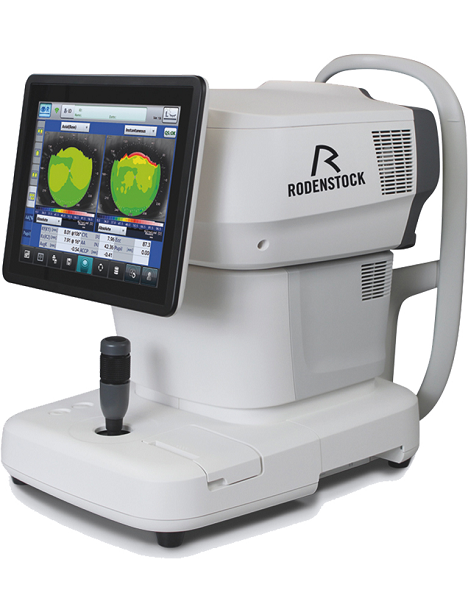
| Rodenstock Alino Multifunction Refractometer
Tune-up your businessExperience 6 analyses in 1 device: Rodenstock Alino Multifunction Refractometer
Are you ready for something that is all-in-one, timesaving, space-saving and suits your business perfectly?Have a look at how powerful ALINO can be.6 in 1 solution01 RefractionHaving a good starting value for subjective refraction is essential. The QUICK REF MODE supports this even for uncooperative patients.02 KeratometryKAI (Kerato-asymmetry index) & KRI (Kerato-regularity index) give the first hint of possible irregularities on the cornea. This supports evaluation of the best vision correction or best-fitting contact lens.03 TonometryThe very gentle air puff created by a new generation of air-flow technology means that patients more readily accept the need for regular check-ups of the IOP measurement.04 PachymetryCorrecting the IOP by measuring the central corneal thickness is essential in interpreting the intraocular pressure.05 TopographyVarious topographic maps support you in carrying out vision screenings, contact lens fittings and in patient education.06 Dry EyeObserve the customers’ eye health and evaluate the long-term tolerability of contact lenses.Take advantage of the combination of tests:Additional servicesTonometry + PachymetryContact lens fitting andtolerance controlKeratometry + Topography + Dry EyeEye healthcareTopography + Tonometry + Pachymetry + Dry EyeSpecifications Rodenstock Alino Multifunction Refractometer
REFRACTIVE POWER MEASUREMENTSpherical refractive power (S) -30.00 D to + 25.00 D (at VD = 12.0 mm)Cylindrical power (C) 0.00 D to ± 12.50 D (at VD = 12.0 mm)Astigmatic axis (A) 0° to 180°KERATOMETRY MEASUREMENTCorneal curvature radius 5.00 mm to 13.00 mmCorneal astigmatic axis 0° to 180°INTRAOCULAR PRESSURE MEASUREMENTMeasurement range 1 mmHg to 60 mmHG (1 hPa to 80 hPa)PACHYMETRY MEASUREMENTMeasurement range 300 μm to 800 μmTOPOGRAPHY MEASUREMENTCorneal curvature radius 5.50 mm to 10.00 mmCorneal astigmatic axis 0° to 180°AUXILIARY FUNCTIONInterpupillary distance Measurement range: 20 mm to 85 mmCorneal diameter and pupil diameter Measurement range: 1.00 mm to 14.00 mmDry eye observation Blinking Analysis, Tear Meniscus height, Hyperemia, Meibomian glandsDATA MANAGEMENTInternal Database Integrated SD CardPrinter Integrated thermal printerData Output Type 3x USB 2.0, 1x LAN, 1x SD Card-slot, 1x WLANExport Format CSV, XML, JPG, PDFDIMENSIONS & ELECTRIC REQUIREMENTSDimensions WDH 312 × 491 × 450 mmWeight Approx. 23 kgVoltage 100 VAC to 240 VACFrequency 50/60 HzPower consumption 110 VA | Righton Retinomax 5 Auto Refractor
The Retinomax Series, the world’s leading handheld autorefractor and autorefractor/keratometer, delivers wide measurement range on par with table type refr, now boasts greater mobility, stability and accuracy. The Retinomax series is widely used as a global standard device for pediatric, screening, medical care in remote areas, disaster area and wide range of ophthalmic scene.FEATURES- View Finder – With view finder observation, no limit of operator age. Diopter adjustable range is +/-8D the same as Retinomax3. View finder arm angle is changeable of 0-135 degrees, making measurement easy regardless of patient’s position or posture. Adjustable diopter +/- 8D.
- Wider Eye Piece – Eye piece relief is 48mm from 32.2mm so that enable to look inside image while even looking at outside. No need to stick eye to the eyepiece all the time.
- Improved battery life – At 180 minutes, the battery capacity is now twice that of conventional models
- Automatic Axis Compensation and Extended Measurement Range – Not only does the device let examiner know the cylinder axis angle, but it can also be automatically adjusted if it is not level
- New Child Mode – While the measurement is being taken, a melody plays continually to keep children’s attention. A constantly changing color display, both on the outside and inside target the device, also keeps children involved during the process.
- Light weight and easy-to-hold grip
View Finder Righton Retinomax 5 Auto RefractorWith view finder observation, no limit of operator age. Diopter adjustable rangeis +/-8D the same as Retinomax3. View finder arm angle is changeable of 0-135degrees, making measurement easy regardless of patient’s position or posture.Adjustable diopter +/- 8D.Improved battery lifeAt 180 minutes, the battery capacity is now twice that of conventional modelsWider Eye PieceEye piece relief is 48mm from 32.2mm so that enable to
look inside image while even looking at outside. No need
to stick eye to the eyepiece all the time.Focus AssistLets you know the exact focusing point with
the following color-coding system.New Child ModeWhile the measurement is being taken, a
melody plays continually to keep children’s
attention. A constantly changing color
display, both on the outside and inside of
the device, also keeps children involved
during the process.Automatic AxisCompensation and extended measurement range
Not only does the device let examiner know the cylinder axis angle, but it can
also be automatically adjusted if it is not level. |




Reviews
There are no reviews yet.